


The 0DTE butterfly strategy is the single most asymmetric structure available on same-day expiration options. You risk a small, defined debit — typically $40 to $150 — and position for a return of 5 to 30 times that amount if price settles near your target. No margin expansion. No overnight exposure. No stop-loss anxiety.
This is the strategy that structural traders use to extract edge from the highest-gamma environment in the options market. It is not a theoretical construct. It is the foundation of how disciplined 0DTE traders build positively skewed return distributions — small controlled losses, occasional outsized wins, and a compounding curve that rewards patience over prediction.
This guide explains exactly how the 0DTE butterfly strategy works, how to select width by VIX regime, when to enter, how to manage profit targets, and what the real performance data shows across hundreds of live sessions on SPX options.
What Is a 0DTE Butterfly Strategy?
A butterfly spread is a three-leg options structure built around a central strike — the body — with two protective wings on either side. On same-day expiration contracts, this structure becomes a precision instrument for capturing price convergence.
The construction is straightforward:
- Buy one lower strike call (or put) — the lower wing
- Sell two at-the-money or near-the-money calls (or puts) — the body
- Buy one higher strike call (or put) — the upper wing
The net cost of this trade is your maximum risk. The maximum profit occurs if SPX settles exactly at the body strike at expiration. Between the wings, profit scales proportionally — the closer price finishes to the body, the larger the return.
A typical 0DTE butterfly on SPX costs $0.40 to $1.50 per contract ($40 to $150) with a maximum return of $9.00 to $25.00 per contract ($900 to $2,500). That is a risk-to-reward ratio of 10:1 to 30:1 in your favor.
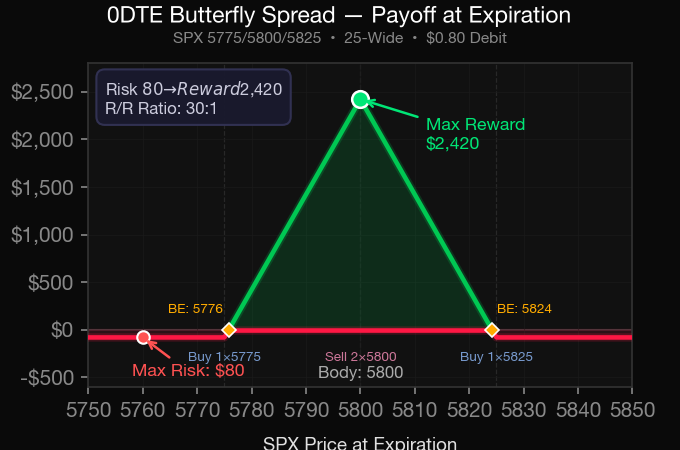
This is the inverse of premium-selling strategies like iron condors, which risk $900 to collect $100. The butterfly flips that math entirely — and on 0DTE contracts where gamma is at its peak, that structural advantage compounds over time.
Why the 0DTE Butterfly Strategy Works on Same-Day Expiration
Butterfly spreads exist on every timeframe, but the 0DTE butterfly strategy has specific advantages that do not exist on longer-dated contracts.
Gamma works for you, not against you. On the final day of an option’s life, gamma reaches its maximum. Small price movements create large changes in option value. For premium sellers, this is destructive — a 15-point SPX move can blow through a short strike in minutes. For butterfly traders, this same gamma accelerates the value of the position as price approaches the body. The physics that destroys iron condors is exactly what powers butterflies.
Theta decay concentrates into hours. A butterfly benefits from time decay on its two short legs at the body. On a 30-day option, this decay happens slowly. On a 0DTE contract, the same decay happens in a single session — compressing weeks of theta into hours. This is why a butterfly that costs $0.60 at 10:00 AM can be worth $5.00 by 2:00 PM if price consolidates near the body.
Defined risk eliminates margin anxiety. Your maximum loss is the debit paid. There is no margin call. No assignment risk on SPX (European-style, cash-settled). No overnight exposure. You know your worst case before you enter. This is not a minor advantage — it is the structural foundation that allows consistent position sizing without the psychological burden of open-ended risk.
Choosing Your 0DTE Butterfly Strategy Width by VIX Regime
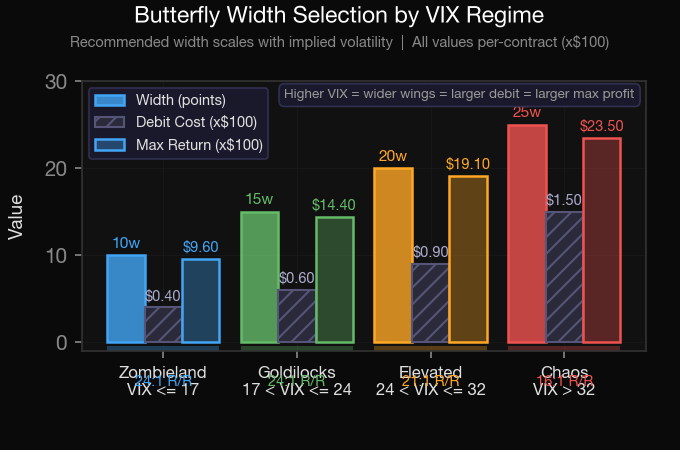
Not all trading sessions are equal. The volatility regime determines how far price is likely to move during the session — and your butterfly width must match that expectation. Using a narrow butterfly in a high-volatility environment is like bringing an umbrella to a hurricane. Using a wide butterfly in low volatility wastes premium on wings that price will never reach.
The four structural regimes and their corresponding butterfly widths:
Zombieland (VIX 17 or below). The market barely moves. Intraday ranges on SPX are compressed to 15-25 points. Use a 10-wide butterfly with a debit of $0.30 to $0.50. The narrow width concentrates your position around a tight zone where price is most likely to settle. Maximum return potential: $9.50 to $9.70 per contract.
Goldilocks (VIX 17 to 24). The sweet spot for 0DTE butterfly trading. Enough movement to create opportunity, not enough to blow through your wings. Use a 15-wide butterfly with a debit of $0.50 to $0.80. This is where the 0DTE butterfly strategy produces its most consistent results. Maximum return potential: $14.20 to $14.50 per contract.
Elevated (VIX 24 to 32). Real volatility. Intraday ranges expand to 40-60+ points. Use a 20-wide butterfly with a debit of $0.70 to $1.10. The wider wings give your position room to breathe as price makes larger swings. Maximum return potential: $18.90 to $19.30 per contract.
Chaos (VIX above 32). Extreme conditions. Use a 25-wide butterfly with a debit of $1.00 to $1.80 — or consider sitting out entirely. Not every session deserves a trade. In chaos regimes, the 0DTE butterfly strategy still works but requires wider structures and smaller position sizes to account for the expanded range.
Entry Timing and Setup for the 0DTE Butterfly Strategy
When you enter matters as much as where you place the body. The 0DTE butterfly strategy is not a trade you put on at the open and forget.
Morning structure (9:45 AM to 11:00 AM ET). Let the first 15 minutes of noise pass. The opening auction creates artificial price action that has nothing to do with the structural environment. By 9:45, the initial positioning is visible — you can see where volume is concentrating, where dealer gamma exposure is pulling price, and whether the session is setting up as range-bound or trending. This is where you establish your directional bias and scenario rank.
Afternoon decay (1:00 PM to 2:30 PM ET). If you missed the morning setup or the morning structure was unclear, the afternoon window offers a second opportunity. By early afternoon, the session character is established. Theta decay is accelerating. A butterfly placed at 1:30 PM has intense time decay working in its favor — and only 2.5 hours of exposure remaining.
Where to place the body. The body of your butterfly goes where you expect price to settle at expiration. This is not a guess. Use the structural tools available — the expected value zone derived from options pricing, the high-GEX magnet strikes where dealer hedging pulls price, and the volume profile showing where the most activity has concentrated. Place the body at the structural center, not at the current price.
Managing the 0DTE Butterfly Strategy — Profit Targets, Not Stop Losses
Here is a fundamental shift in how you think about trade management: with a butterfly, management is about taking profit, not managing risk. Your risk was defined at entry — it is the debit you paid. There is nothing to manage on the downside. The entire management process is about recognizing when to capture gains.
Tier 1: 75% to 200% return on risk. This is the bread-and-butter exit. Your $0.60 butterfly is worth $1.05 to $1.80. Price is near the body with time remaining. This is where you take the majority of your winners. Do not hold for the maximum — the probability of SPX settling exactly at your body strike is low. Capture the profit that the market is offering.
Tier 2: 200% to 500% return on risk. Price is converging on the body with accelerating theta. Your $0.60 butterfly is worth $1.80 to $3.60. This happens when the structural read was correct and the session is playing out as anticipated. Take partial profits and let the remainder ride.
Tier 3: 500%+ return on risk. The runner. Price is pinning near the body in the final hour. Your $0.60 butterfly is worth $3.60 or more. This is the asymmetric payoff that defines the strategy — one runner can pay for ten losing trades. Let it work, but have a trailing mental target. Do not let a 500% winner become a 50% winner because you got greedy.
What about stop losses? You already defined your risk. The debit is the stop loss. Adding a tighter stop to a defined-risk structure defeats the entire purpose. You paid $60 for the right to be in this position until expiration. If you stop out at $30, you just turned a $60 risk trade into a $30 loss with zero chance of recovery. Let the structure work.
Real Performance — What the 0DTE Butterfly Strategy Actually Delivers
These are not hypothetical projections. This is what structural 0DTE butterfly trading produces across live sessions:
Win rate: 45% to 65% depending on VIX regime and width selection. Goldilocks regimes produce the highest win rates. Chaos regimes produce lower win rates but larger individual winners.
Average return on winners: 180% to 350%+ of the debit paid. The asymmetry is the point — your winners are multiples of your losers.
Average loss: 70% to 100% of the debit paid. Roughly half of losing trades reach maximum loss. The other half are closed for partial losses when the structural thesis is clearly invalidated.
Risk per trade: $40 to $150. This is the debit paid. It is the total capital at risk. No margin. No expansion. No surprises.
Break-even win rate required: 10% to 15%. You only need to win one out of every seven to ten trades to break even. In practice, winning 45% to 65% of the time against a 10% to 15% requirement creates a substantial edge — and that edge compounds.
The 0DTE butterfly strategy feels uncomfortable because you lose often. Some weeks, you lose three or four trades in a row. The debit disappears. It feels wrong. But then one trade returns 400% and erases all four losses with profit remaining. That is positive skew in action — and positive skew is the only return distribution that compounds favorably over hundreds of trades.
Common 0DTE Butterfly Strategy Mistakes
These patterns appear repeatedly in the records of butterfly traders who struggle:
Wrong width for the regime. A 10-wide butterfly in a VIX 28 environment has almost no chance. Price will blow through both wings before lunch. Match your width to the volatility regime — always.
Entering before structure develops. Placing a butterfly at 9:31 AM is gambling. The first 15 minutes of price action are noise — opening rotations, overnight order flow clearing, and positioning that has nothing to do with where the session is headed. Wait for structure. The edge is in patience.
Adding stop losses to a defined-risk trade. You already defined your risk at entry. A tighter stop removes optionality without reducing actual risk. If you are not comfortable losing the debit, you sized too large. Fix the sizing, not the structure.
Chasing butterflies after a large move. A 30-point SPX move just happened and you want to place a butterfly at the new price. The problem is that the move already happened. The structural environment has shifted. The expected value zone has moved. Do not chase — wait for the next clean setup.
Sizing too large. Risking $500 per butterfly when your account is $10,000 means five consecutive losers puts you down 25%. The 0DTE butterfly strategy requires consistent sizing in R-multiples. Risk 1% to 2% of your account per trade. This allows the law of large numbers to work in your favor over dozens of trades.
The 4-Step Process for Every 0DTE Butterfly Trade
Every session follows the same structural process. No exceptions.
Step 1 — Regime identification. Check VIX. Determine the structural regime (Zombieland, Goldilocks, Elevated, Chaos). This sets your width, debit budget, and position size before anything else happens.
Step 2 — Structural read. Check gamma exposure, dealer positioning, and the expected value zone. Is this a positive gamma session (range-bound, mean-reverting) or a negative gamma session (trending, amplifying)? Positive gamma sessions favor centered butterflies. Negative gamma sessions favor directional butterflies or sitting out entirely.
Step 3 — Construction. Select your body strike based on the structural read. Set wing width based on the VIX regime. Calculate the debit. Confirm it falls within your R-multiple budget. Execute.
Step 4 — Profit management. Monitor the position against the three profit tiers. Take profits when the market offers them. Do not add stop losses. Do not adjust the wings. Let the structure work or let it expire. The only decision is when to take profit — never when to cut a defined-risk position.
Frequently Asked Questions
What is the best butterfly width for 0DTE?
The best width depends on the VIX regime. In low volatility (VIX 17 or below), use 10-wide butterflies. In normal conditions (VIX 17 to 24), use 15-wide. In elevated volatility (VIX 24 to 32), use 20-wide. In extreme conditions (VIX above 32), use 25-wide or consider not trading. Matching width to the regime is the single most important structural decision in 0DTE butterfly trading.
How much can you make on a 0DTE butterfly?
A single 0DTE butterfly on SPX typically costs $40 to $150 and can return 5 to 30 times the debit paid. A $60 butterfly that reaches maximum value at expiration returns $900 to $2,500 depending on width. In practice, most profitable butterflies are closed at 75% to 350% return on risk rather than held to maximum value. The average winning trade returns 180% to 350% of the debit.
Are 0DTE butterflies risky?
The risk on a 0DTE butterfly is the debit paid — nothing more. There is no margin expansion, no assignment risk on SPX (European-style exercise), and no overnight exposure. A $60 butterfly risks exactly $60. The risk profile is the inverse of premium-selling strategies where you collect a small credit but face a large maximum loss. Butterfly risk is small, defined, and known before entry.
What is the difference between a butterfly and an iron condor?
A butterfly pays a small debit and profits from price convergence near the body — risk $60 to make $900+. An iron condor collects a small credit and profits from price staying in a wide range — collect $100 but risk $900. The risk-to-reward profiles are inverted. The butterfly requires roughly 10 to 15 percent win rate to break even. The iron condor requires approximately 90 percent. Over hundreds of trades, the butterfly’s positive skew compounds favorably while the iron condor’s negative skew works against you.
Can you trade 0DTE butterflies on SPY?
You can, but SPX is structurally superior for 0DTE butterfly trading. SPX options are cash-settled (no assignment risk), European-style (no early exercise), carry Section 1256 tax treatment (60/40 long-term/short-term), and have dramatically higher gamma exposure and dealer hedging flow. SPY butterflies work mechanically but lack the structural depth and institutional positioning that makes SPX the preferred instrument for same-day expiration trading.
Trade Butterflies With the Structure That Creates Them
The 0DTE butterfly strategy is not about predicting where the market will go. It is about reading the structural environment — dealer gamma exposure, VIX regime, volume profile — and positioning a defined-risk structure where the market is most likely to converge. The asymmetry does the rest.
At Fly on the Wall, this structural picture is surfaced before every session. The GEX overlay shows where dealer hedging pulls price. The Market Mode Score integrates gamma exposure with VIX regime for a complete structural read. The expected value zone shows where butterflies have the highest probability of profit — so you place the body with data, not a guess.
Start with the Observer for daily structural analysis and the tools that show you the market’s positioning before the open. Step up to Activator for full execution tools, real-time GEX overlay, and weekly coaching. Or go all-in with Navigator for daily direct coaching with Ernie. Compare all plans here.