

The Mechanism
Your broker shows you price.
Price is the last thing
that moves.
Everything that matters happened before the candle printed. Dealers repositioned. Gamma walls shifted. Institutional flow accumulated at levels your chart shows as random. By the time you see it in price, you’re reacting to something that already occurred.
I built FlyOnTheWall because I wasn’t willing to trade off the last piece of information in the chain. I needed the first piece. This is what that looks like.
Why Retail Platforms Fail the Serious Trader
Retail platforms were built to show you price. Charts, indicators, news feeds — all of it derivative. All of it downstream of the forces that actually move markets.
The data that matters — dealer positioning, gamma exposure, real-time convexity — wasn’t accessible to retail traders. Institutional desks assembled it manually from six different sources before every session. You didn’t have access to those sources. So you traded without it.
The result: technically competent traders making structurally uninformed decisions. The execution is fine. The frame is wrong. That mismatch compounds against you every session.
How Markets Actually Move
Price doesn’t move randomly. It moves within constraints created by the people who have to hedge.
When dealers sell options, they take on gamma exposure. To stay delta-neutral, they hedge — buying when price drops, selling when price rises. That hedging creates predictable gravity. Price gets pulled toward strike clusters where dealer exposure is heaviest. It gets pinned there until the gamma unwinds. Then it releases — fast, directional, and violent if you didn’t see it coming.
Most traders get stopped out at those levels. They mistake dealer hedging zones for resistance. They’re not resistance. They’re mechanics.
This is not a theory. This is the plumbing. Once you see it, you cannot unsee it.
The Regime Problem
The market operates in distinct structural regimes. Compression. Expansion. Transition. The strategy that works in compression destroys you in expansion. Not because you executed wrong — because you brought the wrong playbook to the session.
Before you look at a single setup, you need to know what kind of market you’re in. That’s the Market Mode Score. One number. Every session. Before anything else.
What FlyOnTheWall Reads — Before the Open
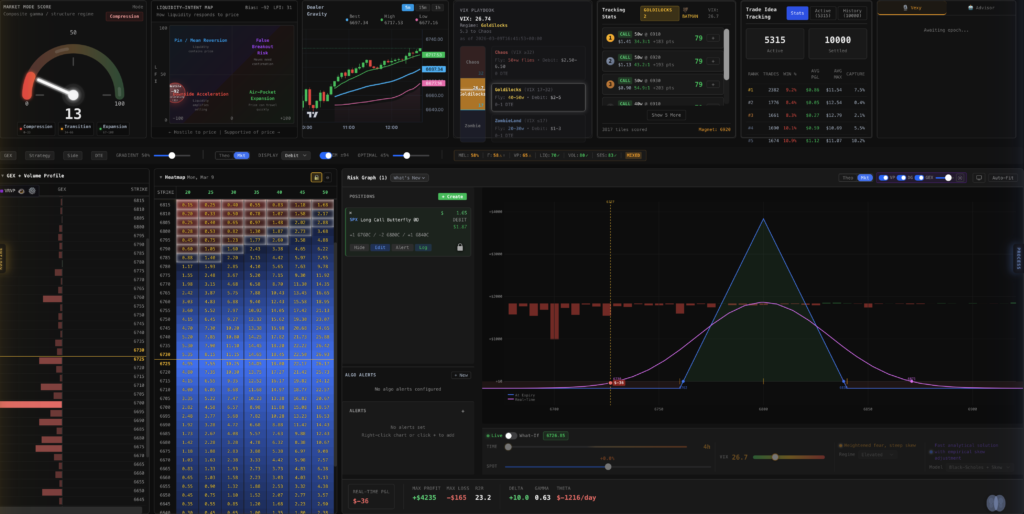
I spent four months building the infrastructure that assembles this picture automatically. Three views, one story. Before 9:30 AM you have everything you need to orient.
Volume Profile shows you exactly where the market agreed on price yesterday and where it didn’t. Value area, point of control, high and low volume nodes — at a glance. Overnight Globex shows you what happened while you were sleeping. Did overnight action respect yesterday’s structure or break it? The GEX Chart shows where dealer positioning is concentrated by strike — where the gamma walls are, where zero is. The options market’s structural skeleton.
Dealer Gravity maps where price is structurally pulled to settle — not a prediction, a structural observation. The Convexity Heatmap surfaces where asymmetric opportunity is building across every expiration — 0DTE butterfly, verticals, singles. Click any tile and the trade template loads directly in TOS.
None of this is prediction. All of it is structural constraint. The market cannot easily violate its own mechanics. That’s the edge.
See Your Position as a Structure, Not a Bet
The Risk Graph shows dual P&L curves — at expiration and real-time — on the same chart. Delta, Gamma, Theta, Vega, max profit, max loss, breakevens. Not approximations. Computed from canonical engines.
The What-If Simulator lets you drag a slider and see what your position looks like two hours from now, at vol crush, at +1% spot move, at expiration. Scenario presets for the moves that actually happen on 0DTE. Your exit rules render as lines on the P&L curve. Your plan is visible geometry.
Position Builder constructs any multi-leg options structure. The builder resolves topology — butterfly, vertical, iron condor — automatically from your legs. One object flows from builder through chart through broker. Nothing gets lost in translation. Analyze before you commit. Cost preview before you confirm. Simulated and live execution through Tradier — same flow, same confirmation, same fill feedback whether you’re paper trading or going live.
Your Practice Record
The Journal is where your daily practice lives. Each day is a page. Write what you noticed, decided, avoided, felt. Your fills appear on the journal day view with structure label and P&L — the Journal reads from the TradeLog, never duplicates data. Readiness Check-In before you trade: sleep, focus, mental state. Voluntary, immutable, correlatable with everything else over time.
The Playbook is where patterns become principles. Organized by context, not date. Three-part rule structure: condition, rule, reason — every word is yours. Flag a journal entry and it becomes raw material for a Playbook rule. Link journal entries as evidence. Watch a rule strengthen as the evidence accumulates. When your open position matches a Playbook rule, the Risk Graph surfaces it.
The Performance Report shows net profit, profit factor, win rate, avg win vs avg loss, max drawdown, and Sharpe ratio. Your equity curve. Your drawdown. Your return distribution. Not a scorecard — a diagnostic. The system shows you exactly where your edge is compounding and where it’s leaking.
Vexy — The Intelligence Layer
Vexy is not a chatbot. She is a reasoning partner that operates under strict constraints. She cannot tell you what to do. Cannot predict direction. Cannot size positions. Cannot generate signals. That constraint is architectural, not a preference.
She knows what’s on your Risk Graph, what’s in your Journal, which Playbook rules are active, and what your readiness state is. Every conversation is grounded in your actual work. A conversation at 9:45 AM in the Morning session is structurally different from one at 3:30 PM in Power Hour. She knows the difference.
She helps you write journal entries and Playbook rules through guided interviews. You answer questions about what happened. She assembles the draft. You edit and approve. The writing is always yours.
The longer you trade with her, the sharper the questions get — until you don’t need her to ask them anymore. That’s the goal. That’s the whole point.
What This Platform Does Not Do
Does not tell you what to trade. Does not predict price direction. Does not size positions for you. Does not generate trade signals. Does not gamify your practice. Does not compare you to other traders. Does not manufacture urgency.
The system develops your capacity. You make the decisions. The risk is yours.
This is not a signal service.
See the mechanism in the platform →Ready to evaluate
Observer — $17/week
Four weeks. Full platform access. Every session. Either the structural edge is real or it isn’t. That’s the only evaluation that matters.