


The 0DTE butterfly strategy is the closest thing options trading has to an unfair advantage. You risk $40 to $150 per trade. Your potential return is 5 to 35 times that risk. And the best part — you know your maximum loss before you enter the trade.
This isn’t a strategy guide written by someone who read about butterflies in a textbook. This is how we actually trade 0DTE butterfly spreads on SPX every day, managing real capital in real time.
If you’ve been selling credit spreads, trading iron condors, or chasing directional plays with single-leg options — you’re going to understand why the 0DTE butterfly strategy changes everything.
What Is a 0DTE Butterfly?
A 0DTE butterfly is a three-legged options structure that you open and close on the same day — zero days to expiration. You’re buying a cheap bet that SPX will land inside a specific price zone by market close.
The anatomy is simple: you buy one lower strike call (or put), sell two calls at the middle strike, and buy one higher strike call. The middle strike is the body — that’s where you want price to land. The outer strikes are your wings. They define your risk. For a deeper look at directional versus neutral placement, see our guide on directional versus neutral placement.
Why is the 0DTE butterfly strategy considered asymmetric? Because you’re risking the debit you paid — typically $0.40 to $1.50 per contract ($40 to $150) — while the maximum value of a 10-wide butterfly at expiration is $10.00 ($1,000). That’s 5x to 25x on your money. On wider butterflies or perfect placements, you can see 35x.
The risk is binary and known. You can never lose more than what you paid. No margin calls, no gap risk overnight, no stop-loss anxiety. The trade expires at the end of the day. If you’re new to the butterfly spread concept, the structure is worth understanding before diving into the 0DTE application.
Why Butterflies Beat Credit Spreads and Iron Condors
Most 0DTE traders start with credit spreads. They sell an out-of-the-money spread, collect $0.50 in premium, and risk $9.50 to keep it. That’s a 19:1 adverse risk-to-reward ratio. One bad move and you take maximum loss.
Credit spreads put you underwater from the moment the market moves against you. The premium you collected erodes while your risk stays full size. Your entire strategy depends on the market not doing something — and in a 0DTE environment, SPX moves 30 to 80 points on a typical day.
Iron condors need static conditions. You’re selling both sides, hoping the market stays in a range. When it doesn’t — and in 0DTE time frames, it frequently doesn’t — you’re exposed on one side with full risk.
The 0DTE butterfly strategy flips this completely:
- Risk is defined at entry. You pay the debit, that’s your maximum loss. Period.
- Reward is asymmetric. Small risk, disproportionately large potential return.
- No stop-loss management. The structure itself is the risk control. You don’t need to micromanage.
- You profit from movement. Unlike credit spreads that need the market to stay still, butterflies thrive when you correctly identify direction.
Here’s the comparison in real numbers:
Credit Spread: Risk $950, collect $50. Need 95% win rate just to break even.
Iron Condor: Risk $700, collect $300. One directional day wipes weeks of premium.
0DTE Butterfly: Risk $75, potential return $375 to $750. Win 50% of the time and you’re massively profitable.
The math isn’t close.
Choosing Your Butterfly Width by VIX Regime
Not all market environments are the same, and your 0DTE butterfly strategy should adapt. We use VIX regimes — not gut feeling — to determine butterfly width and debit targets.
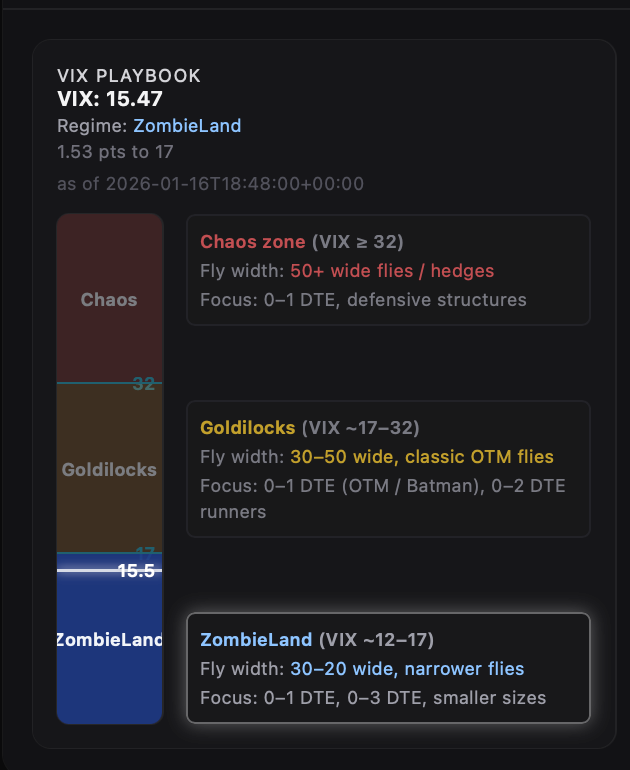
Zombieland (VIX ≤ 17) — The market is sleepy. Expected moves are compressed. Use tighter butterflies — 8 to 12 wide. Debit: $0.30 to $0.60. The market isn’t going to make dramatic swings, so you place your body closer to the current price and play for precision. Return profile: 8-20x on the debit.
Goldilocks (VIX 17–32) — The sweet spot. This is where most trading days fall. Use standard butterflies — 10 to 20 wide. Debit: $0.40 to $1.00. There’s enough movement to reach your zone, and the premium structure works in your favor. This regime produces the most consistent butterfly opportunities.
Chaos (VIX > 32) — The market is volatile and options are expensive. Use wider butterflies — 15 to 30 wide. Debit: $0.80 to $1.50. The wings need to be wider because SPX can move 100+ points in a session. The debits are higher, but so are the potential returns. Placement matters more here — you’re playing for the bigger moves.
Example: VIX is at 14 (Zombieland). You’re looking at a 10-wide SPX options butterfly. You buy the 5830 call, sell two 5840 calls, buy the 5850 call. Total debit: $0.40 ($40 per contract). If SPX closes at 5840, that butterfly is worth $10.00 ($1,000). That’s a 24:1 return on risk — on $40 of capital at risk.
The regime tells you the width. The width determines the debit. The debit is your total risk. There’s no ambiguity.
Entry Timing and the Setup
When you enter matters as much as where you place it. Your 0DTE butterfly strategy should account for three distinct trading windows during the session.
Morning session (9:30 AM – 11:30 AM ET): This is the structural phase. The market is finding its direction. Wait for the first 15 to 30 minutes of noise to settle, then look for directional bias. Butterflies placed in the morning give you the full day for price to reach your zone — but you’re buying with more time value, so debits are slightly higher.
Afternoon session (12:00 PM – 2:30 PM ET): Time decay accelerates. Butterflies get cheaper as the day progresses. If you have a clear directional read, afternoon entries offer better debit-to-reward ratios. The trade-off: less time for the market to reach your zone.
Closing session (2:30 PM – 4:00 PM ET): The cheapest butterflies — but also the highest precision required. Only enter here if you have high conviction on where SPX will close. This is where runners happen (500%+ returns), but also where the most butterflies expire worthless.
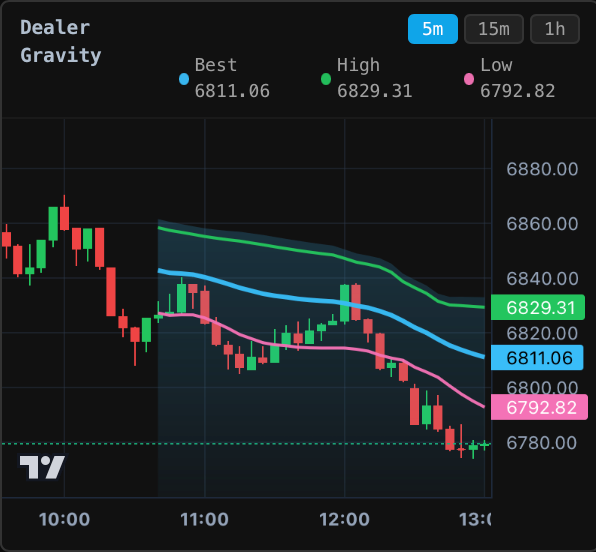
For directional bias, we use a simple toolkit: volume profile levels from the overnight session, Dealer Gravity (gamma exposure models showing where dealers are hedging), and the 50 EMA as a trend filter. When these tools align on a direction, you place the butterfly body 10 to 30 points in that direction from the current price.
You’re not predicting exact prices. You’re identifying zones where SPX is likely to settle.
Managing the Trade — Profit Targets, Not Stop Losses
Here’s where the 0DTE butterfly strategy differs from everything else you’ve traded: management is about taking profit, not managing risk.
Your risk was defined at entry. The debit you paid is the most you can lose. There’s nothing to “manage” on the downside. The structure handles that for you.
What you manage is the exit:
- 75-200% return on debit: This is your bread and butter. Your $0.50 butterfly hits $1.25 to $1.50. Take profit. This happens on the majority of winning trades.
- 200-500% return: Strong setups. The market is moving into your zone with momentum. Consider taking partial profit (half the position) and letting the rest ride.
- 500%+ return (runners): These are the trades that make the entire strategy work. Your $0.40 butterfly is worth $2.00, $3.00, or more. Let it run. These happen maybe once or twice a week, and they pay for all the losers and then some.
The key insight: you don’t need stop losses on a defined-risk trade. You defined the risk when you bought the butterfly. Moving a “stop” on a butterfly is nonsensical — you’d be closing out a $40 risk trade for a $20 loss, cutting your opportunity in half while “saving” $20. Let the structure work.
Some days the butterfly expires worthless. That’s the cost of doing business. Your $40 to $150 loss is priced in from the start. The winners more than compensate.
Real Performance — What to Actually Expect
We’re not going to sugarcoat this. Here’s what the 0DTE butterfly strategy actually looks like in practice:
Win rate: 45-65% depending on the VIX regime and your skill at reading direction. Higher in Goldilocks conditions, lower in Chaos.
Average return on risk: 180%+ across all trades (winners and losers combined). That means for every dollar risked, the average outcome is $1.80 in return. This is the power of asymmetry — your winners are dramatically larger than your losers.
Return distribution:
- ~65% of winning trades return 75-200% on the debit
- ~25% return 200-500%
- ~10% return 500%+ (the runners that make the strategy exceptional)
Loss profile: Approximately half of losing trades hit max loss (butterfly expires worthless). The other half are partial losses where you close before expiration to redeploy capital.
Risk per trade: $40 to $150. This is not a strategy that requires large capital. You can trade butterflies with a $5,000 account.
You’re going to lose almost half your trades. That’s the point. The strategy is designed so that your losing trades are small and bounded, while your winning trades are multiples of the risk. You’re engineering the distribution of outcomes — small losses, rare but meaningful gains.
This is what positive skew looks like in practice.
Common Mistakes That Kill Butterfly Traders
Wrong width for the regime. Trading a 10-wide butterfly when VIX is at 35 is like bringing a knife to a gunfight. The market will blow through your zone before lunch. Match the width to the regime.
Entering too early. Placing butterflies at market open before any structure has developed is gambling, not trading. Wait for the first 15 to 30 minutes to reveal direction. Patience is a structural advantage.
Moving stops on a defined-risk trade. The butterfly IS the risk management. Closing it early for a “smaller loss” means you paid the premium but didn’t give it a chance to work. You already defined your risk when you entered — honor it.
Chasing after a big move. SPX just dropped 40 points and you want to place a butterfly at the bottom? The easy money already happened. Don’t chase. Wait for the next setup.
Sizing too large. Any 0DTE butterfly strategy lives or dies by position sizing. Risk per trade should be consistent and small relative to your account. If you’re risking more than 2-3% of your account on a single butterfly, you’re not managing risk — you’re gambling with the right structure. Think in R-multiples: 1R risk per trade, consistent sizing, let the asymmetry compound.
The 4-Step Process for 0DTE Butterfly Trading
Step 1 — Macro and micro analysis. Before the market opens, check the VIX regime (this determines your width), overnight futures direction, economic calendar, and any gap scenarios. This takes five minutes and sets the framework for the day.
Step 2 — Market structure and scenario ranking. In the first 15 to 30 minutes of the session, identify key levels using volume profile, Dealer Gravity, and the 50 EMA.
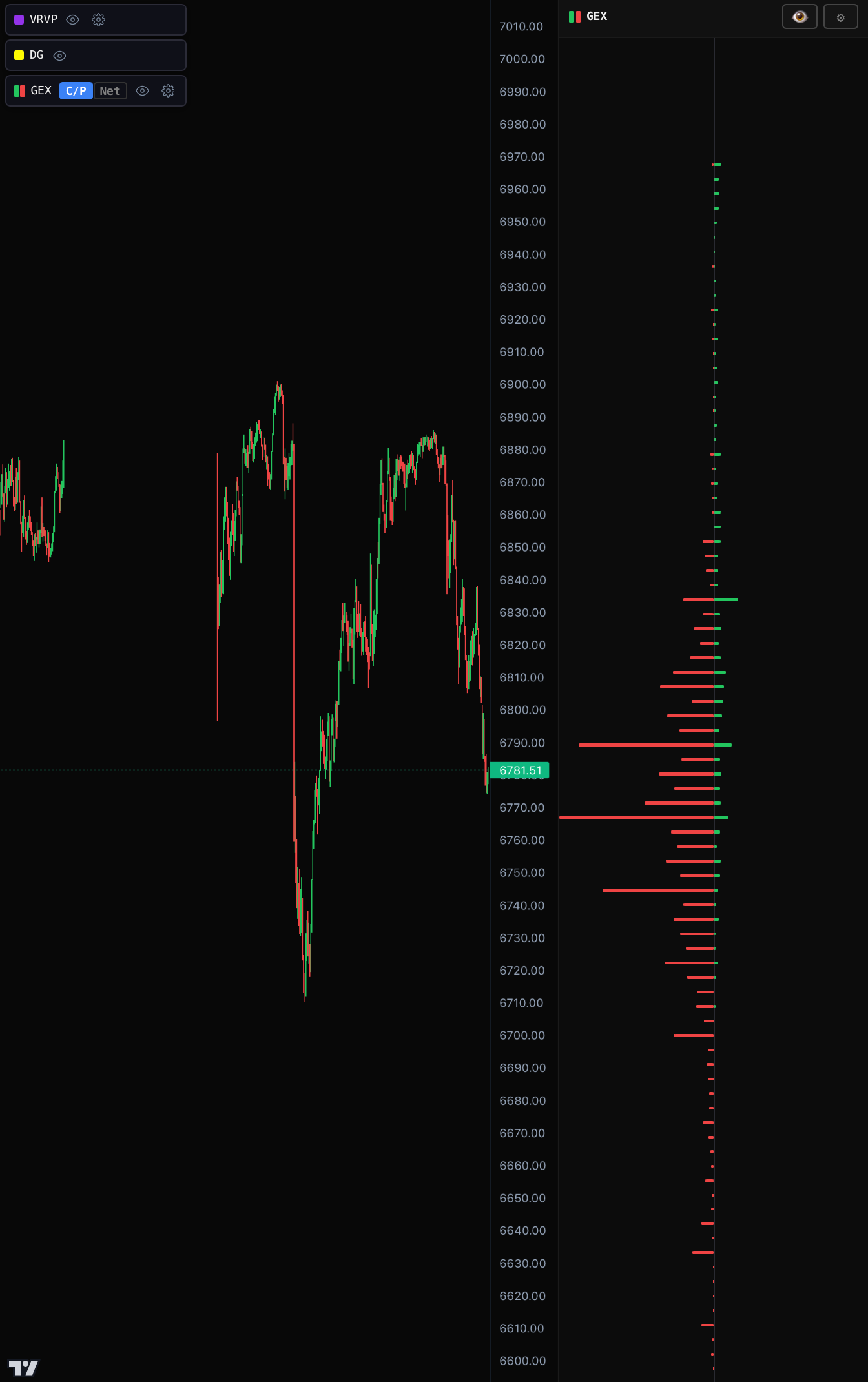 Rank your directional scenarios: where is SPX most likely to settle? List your top two or three zones.
Step 3 — Butterfly construction. Select your width based on the VIX regime. Place the body at your highest-probability zone. Calculate the debit. If the debit-to-width ratio gives you at least 5:1 potential return, the trade qualifies. Enter the position.
Step 4 — Profit management. Set your profit targets before entering. Monitor the trade. Take profit at your tiers (75%, 200%, 500%+). If the butterfly approaches worthless with less than 30 minutes to expiration and the market isn’t near your zone, consider closing for any remaining value. Otherwise, let it expire.
That’s the whole system. Macro analysis, structure identification, butterfly placement, profit management. No indicators, no complicated Greeks calculations, no second-guessing. The structure handles the complexity.
Frequently Asked Questions About 0DTE Butterfly Spreads
What is the best butterfly width for 0DTE options?
The best width depends on the VIX regime. In low volatility (VIX under 17), use 8-12 wide butterflies. In normal conditions (VIX 17-32), use 10-20 wide. In high volatility (VIX above 32), use 15-30 wide. The regime determines the width — never trade the same width regardless of conditions.
How much can you make on a 0DTE butterfly?
A single 0DTE butterfly trade can return 5x to 35x the initial debit. A $0.50 debit butterfly ($50 risk) can return $250 to $500 on a typical winning trade, and occasionally $1,000+ on a runner. Average return across all trades (winners and losers) exceeds 180% of risk deployed.
Are 0DTE butterfly spreads risky?
The 0DTE butterfly is one of the lowest-risk options structures available. Your maximum loss is limited to the debit you pay — typically $40 to $150 per trade. There is no margin risk, no overnight exposure, and no possibility of losing more than the initial cost. The risk is defined, known, and small.
What’s the difference between a butterfly spread and an iron condor?
A butterfly is a directional structure that profits when the market reaches a specific zone. An iron condor is a non-directional structure that profits when the market stays within a range. Butterflies have asymmetric risk-reward (small risk, large potential gain). Iron condors have inverted risk-reward (small gain, large potential loss). In 0DTE trading, butterflies consistently outperform iron condors because the SPX moves too much in a single day for range-bound strategies to work reliably.
Can you trade 0DTE butterflies on SPY instead of SPX?
You can, but SPX is superior for 0DTE butterfly trading. SPX options are European-style (cash-settled, no early assignment risk), receive favorable 60/40 tax treatment, and have tighter bid-ask spreads in the 0DTE chain. SPY butterflies work in smaller accounts since SPY is 1/10th the price of SPX, but you’ll deal with wider relative spreads and American-style exercise risk.
Ready to Trade Butterflies With Structure?
The 0DTE butterfly strategy isn’t complicated. The hard part isn’t the mechanics — it’s building the discipline to trust the asymmetry, size correctly, and let the losers expire without flinching.
That’s what we do at Fly on the Wall. Daily live sessions trading butterflies in real time. A Discord community of traders sharing setups, width decisions, and regime analysis. Structured coaching that builds the habits that make the strategy work.
Whether you’re starting with the Observer for real-time tools and daily market analysis, stepping up to Activator for full execution tools and weekly coaching, or going all-in with Navigator for daily direct coaching — you’ll be trading with a framework, not guessing. Compare all plans here.