


When do SPX options expire? It’s the first question every index options trader needs to answer — and getting it wrong can mean the difference between a controlled exit and a surprise settlement you didn’t plan for. SPX options have unique expiration rules that set them apart from equity options like SPY, and understanding these rules is non-negotiable if you’re trading same-day expiration contracts.
Unlike stock options that expire on the third Friday of each month, SPX options have multiple expiration cycles running simultaneously — monthly, weekly, and daily. Each follows different timing rules for when trading stops and when settlement prices are calculated. This guide covers every expiration detail you need to know.
SPX Options Expiration Time: When Do They Actually Expire?
The answer depends on which SPX options contract you’re trading. There are two distinct expiration types, and they settle at different times:
PM-Settled SPX Options (SPX Weeklys and Dailies)
PM-settled SPX options — which include all weekly expirations (SPXW) and the daily 0DTE contracts — expire at the close of trading on expiration day at 4:00 PM ET. The settlement value is based on the closing prices of the component stocks in the S&P 500 index at that day’s market close.
Key details for PM-settled contracts:
- Last trading time: 4:00 PM ET on expiration day
- Settlement calculation: Based on closing prices of S&P 500 component stocks
- Settlement style: European (cash-settled, no early exercise)
- Trading available: Monday through Friday, 0DTE contracts available every trading day
This is the expiration type that matters most for 0DTE traders. When you buy or sell a butterfly, iron condor, or any other structure expiring today, you’re trading PM-settled contracts that cease to exist at the 4:00 PM close.
AM-Settled SPX Options (Monthly Standard)
The original monthly SPX options (third Friday of each month) are AM-settled, meaning their settlement value is determined by the opening prices of S&P 500 component stocks on expiration Friday morning. This is the Special Opening Quotation (SOQ), calculated from the opening auction prices.
Key details for AM-settled contracts:
- Last trading day: The business day before expiration (typically Thursday)
- Settlement calculation: Based on opening prices on Friday morning (SOQ)
- Settlement style: European (cash-settled)
- SOQ timing: Usually determined within the first few minutes of the opening auction, but can take up to 30 minutes if component stocks are delayed
Critical distinction: You cannot trade AM-settled standard monthly SPX options on their expiration Friday. Your last chance to exit is Thursday’s close. Many traders have been caught off guard by this rule, holding monthly SPX options into Friday morning thinking they could still trade them.
SPX Options Expiration Calendar: Which Days Have Expirations?
As of 2024, SPX options expire every single trading day. This is a dramatic expansion from the historical schedule and is what makes 0DTE trading possible.
Here’s the complete SPX expiration schedule according to the CBOE’s product specifications:
- Daily expirations (0DTE): Monday through Friday. PM-settled. These are the contracts that expire the same day you trade them.
- Weekly expirations: Every Friday (PM-settled SPXW). These overlap with daily contracts on Fridays.
- Monthly expirations (standard): Third Friday of each month. AM-settled (SPX, not SPXW). Last trading day is Thursday.
- Monthly expirations (end-of-month): Last business day of each month. PM-settled.
- Quarterly expirations: Third Friday of March, June, September, December. AM-settled. These carry additional significance due to “triple witching” effects.
On most trading days, multiple SPX expiration cycles are active simultaneously. A typical Monday might have daily contracts expiring that day, plus weeklies expiring Friday, monthlies expiring in two weeks, and LEAPs expiring months out. Each has different implied volatility, Greeks behavior, and Greeks sensitivity.
What Happens When SPX Options Expire In the Money?
SPX options are European-style and cash-settled. This means two things that fundamentally differ from stock options:
- No early exercise: You cannot exercise an SPX option before expiration, and nobody can exercise against you early. This eliminates assignment risk entirely — a major advantage over SPY options.
- Cash settlement: If your SPX option expires in the money, you don’t receive (or deliver) shares of anything. Instead, you receive the cash difference between the strike price and the settlement value. For example, if you hold a 5800 call and SPX settles at 5810, you receive $1,000 (10 points × $100 multiplier) per contract.
This cash settlement process happens automatically. You don’t need to take any action — your broker handles the calculation and credits (or debits) your account, typically by the next business day.
For spread structures like butterflies and credit spreads, each leg settles independently. If your butterfly’s center strikes are in the money and the wings are out, you receive the net cash value based on how each individual option settles.
SPX Options Expiration vs SPY: Key Differences
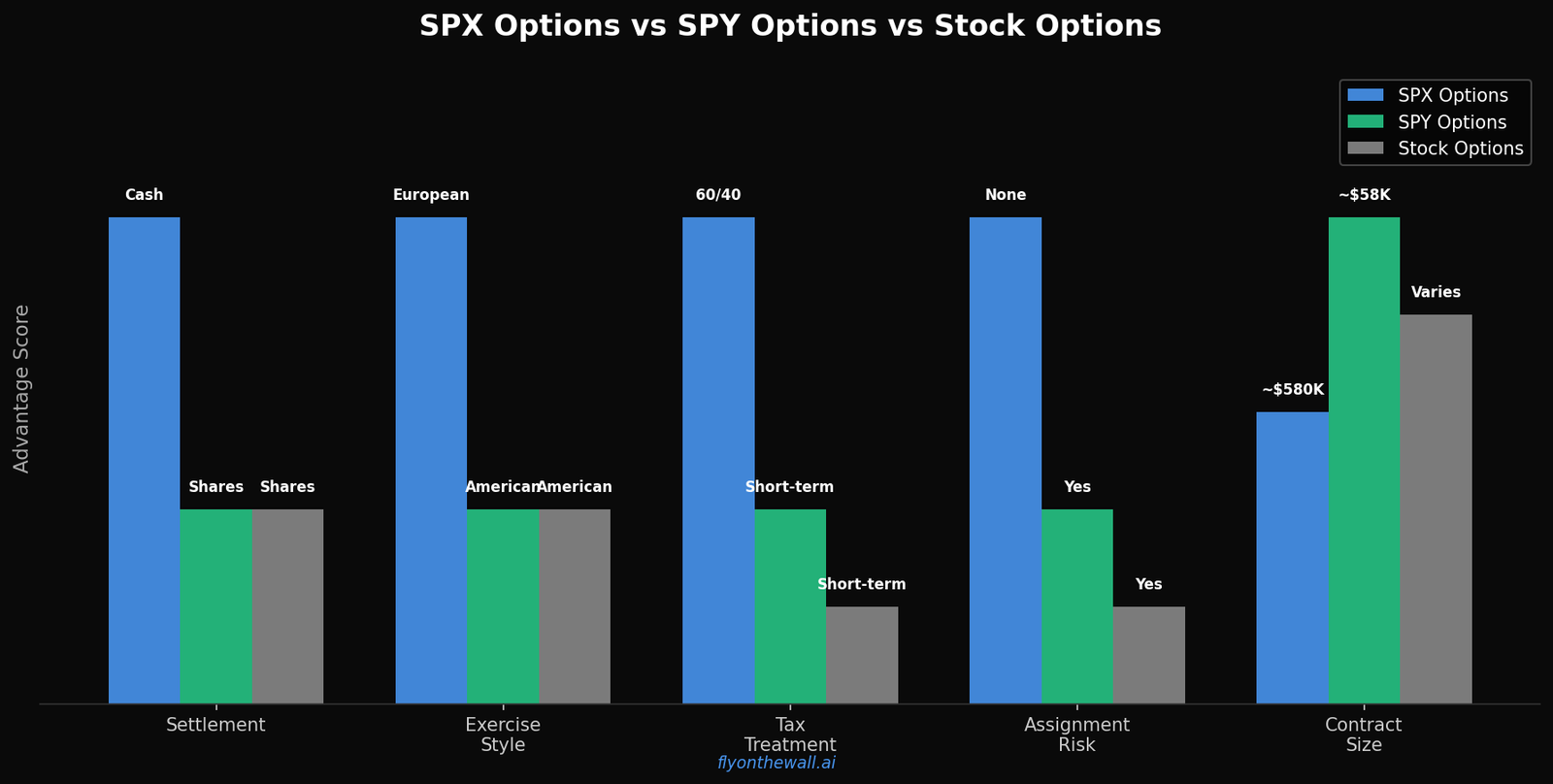
Understanding the differences between SPX and SPY option expirations is critical for choosing the right instrument:
| Feature | SPX Options | SPY Options |
|---|---|---|
| Settlement | Cash-settled | Physical delivery (shares) |
| Exercise style | European (no early exercise) | American (early exercise possible) |
| Expiration time (daily/weekly) | 4:00 PM ET | 4:00 PM ET |
| Assignment risk | None | Yes, can happen any time |
| After-hours risk | None (settles at close) | Yes (share movement after close) |
| Tax treatment | Section 1256 (60/40 split) | Standard short/long-term rates |
The cash settlement and European exercise style make SPX options significantly cleaner for expiration-day trading. There’s no pin risk, no after-hours assignment surprise, and no need to manage share positions that appear in your account over the weekend.
SPX Options Expiration Day: What 0DTE Traders Need to Know
If you’re trading 0DTE — which means your options expire the same day you open them — here are the expiration-specific dynamics that directly affect your trading:
Gamma Acceleration Near Close
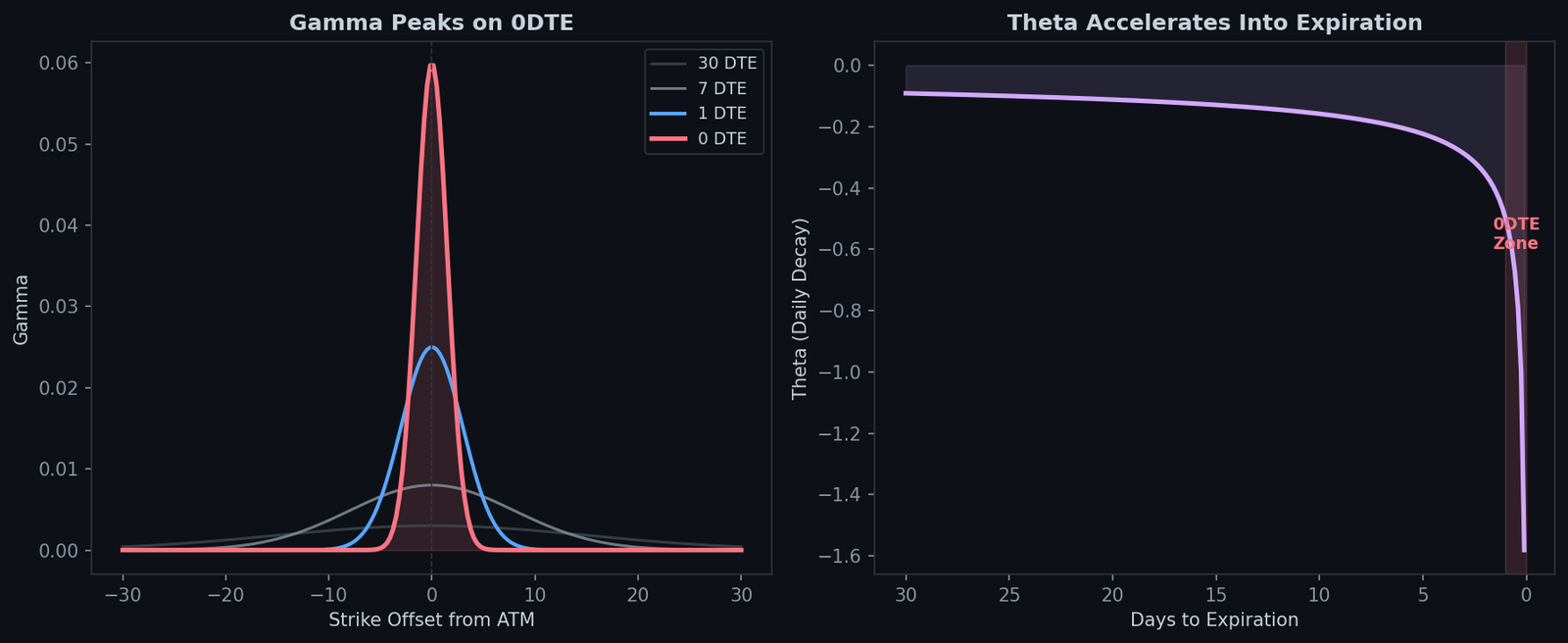
Gamma exposure peaks as expiration approaches. In the final hour of trading, at-the-money options see their delta swing violently with small price moves. A butterfly that was safely positioned at 2:00 PM can become a full directional bet by 3:30 PM. This is why options risk management demands a latest exit time — most experienced 0DTE traders close or trim positions by 3:30 PM ET at the latest.
IV Crush Into the Close
Implied volatility on 0DTE options collapses throughout the day as time premium evaporates. This IV crush is most dramatic in the final 90 minutes. Short premium strategies (iron condors, credit spreads) benefit from this collapse. Long premium strategies (straddles, debit spreads) must overcome it with sufficient directional movement.
Liquidity Considerations
SPX 0DTE options are among the most liquid derivatives in the world, but liquidity is not uniform throughout the day. Bid-ask spreads tend to be tightest between 10:00 AM and 3:00 PM ET. They widen in the first 15 minutes after the open (as market makers adjust) and in the final 15 minutes before close (as gamma risk peaks and market makers reduce exposure).
Settlement Timing for Same-Day Positions
When your 0DTE position expires, the cash settlement typically posts to your account by the next business day morning. If you have a straddle or multi-leg position, each leg settles independently against the same settlement price. Your broker calculates the net credit or debit across all legs and adjusts your account accordingly.
Common SPX Options Expiration Mistakes
Even experienced traders get tripped up by SPX expiration mechanics. Avoid these pitfalls:
- Trading standard monthly SPX on expiration Friday: AM-settled monthlies stop trading Thursday. If you try to close on Friday, you’ll find you can’t — the position has already settled based on Friday’s opening prices.
- Ignoring the AM/PM settlement distinction: If you’re holding a standard monthly SPX option thinking it settles at 4 PM Friday, you could be wrong by 7 hours. Check the contract specifications.
- Holding 0DTE through the close “for max profit”: Gamma makes the last 30 minutes extremely unpredictable. A winning butterfly can become a loser in the final minutes of trading. Take profits before 3:30 PM.
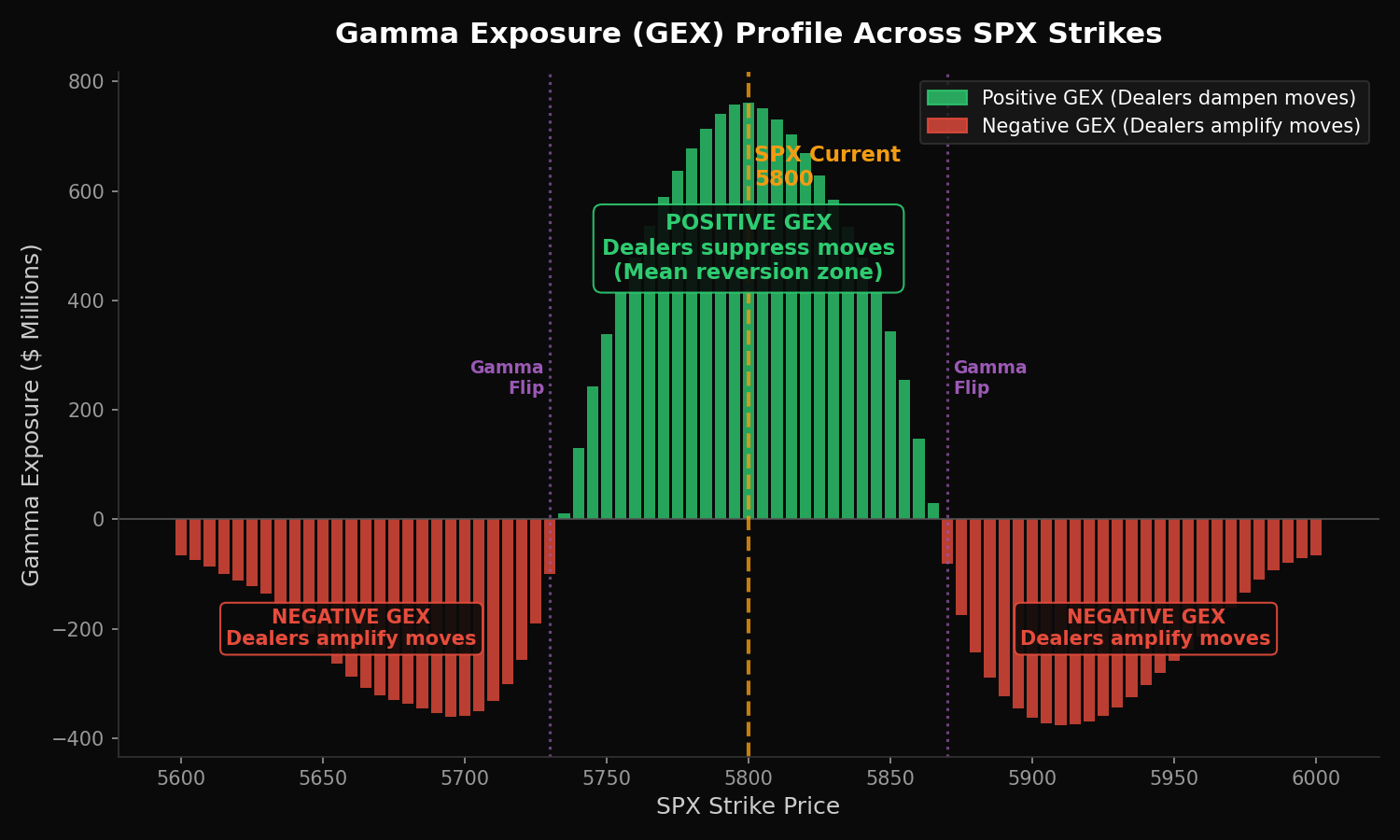
- Forgetting about gamma squeeze risk: Large open interest at specific strikes can cause amplified moves as dealers hedge near expiration. Check GEX levels before holding through late-day trading.
- Confusing SPXW with SPX: These are different products with different settlement rules. SPXW (weeklies/dailies) are PM-settled. SPX (standard monthly) are AM-settled. Your broker should distinguish them, but always verify.
Section 1256 Tax Treatment and SPX Expiration
SPX options qualify for Section 1256 tax treatment under the Internal Revenue Code. This means regardless of how long you hold the position — even if it expires the same day you opened it — gains and losses are taxed as:
- 60% long-term capital gains (lower tax rate)
- 40% short-term capital gains (ordinary income rate)
This applies to every SPX trade including 0DTE. For an active trader in the 37% federal bracket, Section 1256 treatment can reduce effective tax rates significantly compared to SPY options, which are taxed entirely as short-term gains for positions held less than a year. This tax advantage is one of the key reasons professional 0DTE traders prefer SPX over SPY.
Frequently Asked Questions
What time do SPX options expire?
PM-settled SPX options (weeklies, dailies, and 0DTE contracts) expire at 4:00 PM ET when the market closes. Standard monthly SPX options (third Friday) are AM-settled, meaning they stop trading on Thursday and settle based on Friday’s opening prices of S&P 500 component stocks.
Do SPX options expire at 4 PM?
Daily and weekly SPX options (SPXW) expire at 4:00 PM ET, settling based on closing prices. However, standard monthly SPX options are AM-settled and their settlement price is calculated from the opening auction on expiration Friday morning, not the close. Always check whether your contract is PM-settled (SPXW) or AM-settled (standard SPX monthly).
What happens when SPX options expire in the money?
SPX options are cash-settled. If your option expires in the money, you receive the cash difference between the strike price and the settlement value. For example, a 5800 call with SPX settling at 5815 pays $1,500 per contract (15 points times the $100 multiplier). This cash settlement happens automatically through your broker, typically by the next business day.
Can SPX options be exercised early?
No. SPX options are European-style, meaning they can only be exercised at expiration — and since they’re cash-settled, “exercise” simply means automatic cash settlement. There is no early exercise risk with SPX options, which eliminates assignment risk entirely. This is a significant advantage over American-style options like SPY.
What is the difference between SPX and SPXW options expiration?
SPX refers to the original standard monthly contracts that are AM-settled (settlement based on Friday opening prices, last trading day is Thursday). SPXW refers to the weekly and daily contracts that are PM-settled (settlement based on closing prices on expiration day, tradeable until 4:00 PM ET). Most 0DTE trading uses SPXW contracts. Your broker’s option chain should clearly indicate which type you are trading.