


Learning how to trade 0DTE options is not about memorizing a setup. It is about building a process — a repeatable sequence that starts with reading the session, selecting a structure, timing an entry, and managing risk with precision. Same-day expiration contracts on SPX move fast, decay fast, and punish hesitation. But for traders who approach them structurally, 0DTE options offer asymmetric opportunities that no other instrument provides.
This guide walks through the practical steps of trading 0DTE options from start to finish. Not theory — process. If you are new to the concept, start with what 0DTE options are and how they work. If you already understand the basics and want to know how to actually execute, this is where you start.
How to Trade 0DTE Options: What You Need Before Your First Session
Before you place a single trade, you need three things in place. Skip any one of them and the speed of 0DTE will expose the gap immediately.
A broker that supports SPX options with real-time data. You need a platform that shows live SPX option chains with accurate bid-ask spreads and Greeks. Delayed data is useless when the contract you are trading expires in hours. Most serious 0DTE traders use thinkorswim, tastyworks, or Interactive Brokers — platforms built for options execution, not stock picking.
A working knowledge of options fundamentals. You do not need to be an expert, but you must understand the Greeks — specifically delta, gamma, and theta — because they govern how your position behaves throughout the session. Delta tells you directional exposure. Gamma tells you how fast that exposure changes. Theta tells you how much value time decay removes each hour. On 0DTE, theta is a cliff and gamma is a rocket. If those concepts are unfamiliar, study them before risking capital.
A defined risk budget for every session. Decide before the session opens how much you are willing to lose today. Not how much you hope to make — how much you can lose and still trade tomorrow. For most developing traders, that number should be 1-2% of the trading account. This is the single most important decision you make each day, and it must be made before the market opens, not during it.
Reading the Session Before You Place a Trade
Every 0DTE session has a structural context that determines which setups have edge and which are traps. Reading that context is what separates structural traders from gamblers.
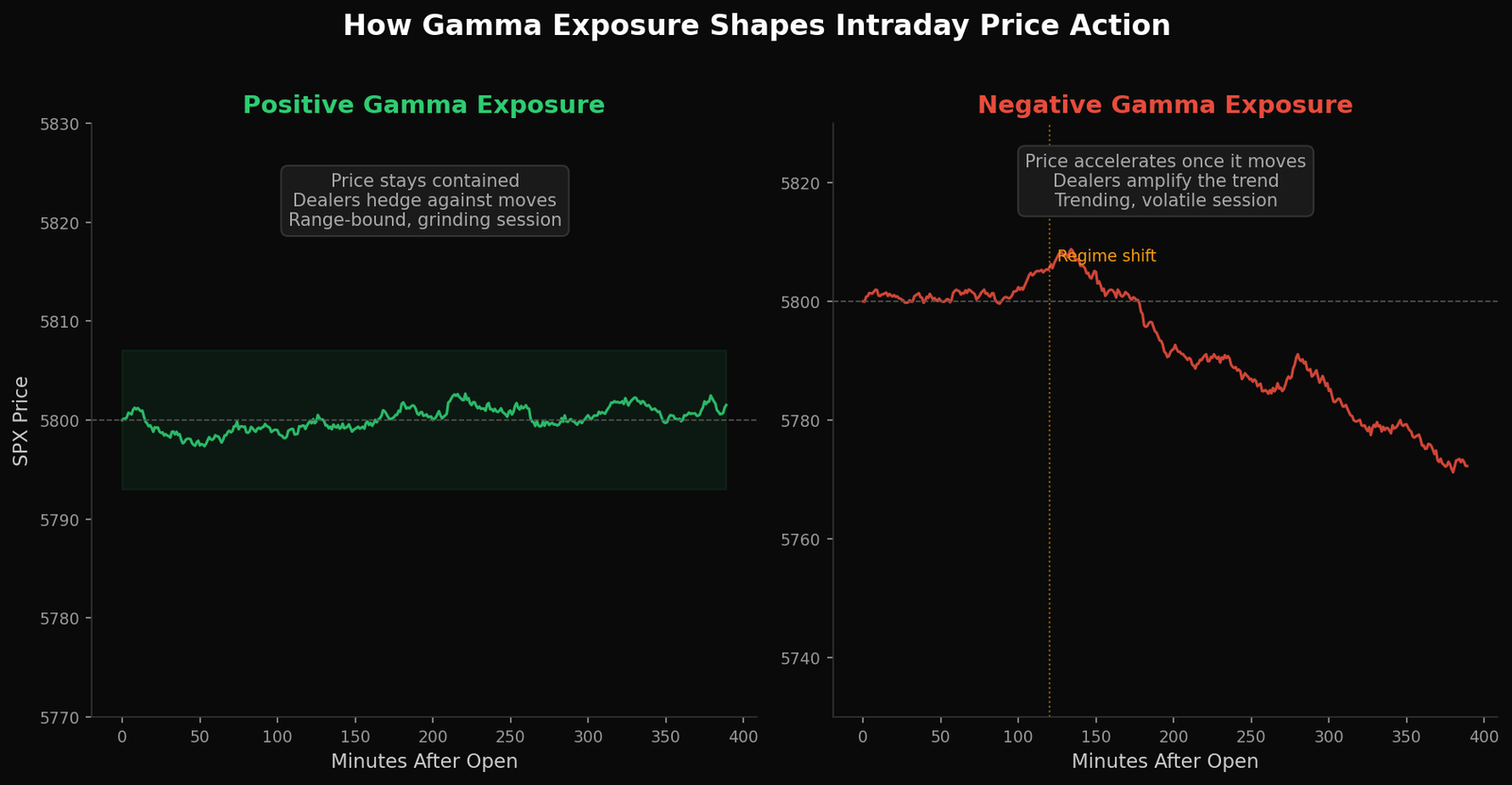
Gamma exposure (GEX) tells you how dealers will behave. When aggregate GEX is positive, market makers are positioned to dampen moves — they buy dips and sell rallies, which compresses the trading range. When GEX is negative, dealers amplify moves — they sell into selloffs and buy into rallies, which expands the range. The GEX profile for the session shapes everything: your structure width, your strike selection, and your expectations for price movement.
The expected move defines your range. The expected move is the implied range the market is pricing for the session, derived from the at-the-money straddle price. It gives you a probabilistic boundary — price is expected to stay within this range roughly 68% of the time. Your structure placement should reference this range, not arbitrary support and resistance levels from a chart.
The VIX regime sets the volatility context. A VIX below 15 means tight ranges and fast theta decay — narrow structures work. A VIX above 25 means wide ranges and violent moves — you need wider structures and smaller position sizes. The VIX is not a trade signal. It is a regime indicator that determines how aggressively you can size and how wide your structures should be.
Catalysts change everything. FOMC days, CPI releases, and jobs reports create regime shifts within the session. If there is a major economic release on the calendar, the session before and after the print will trade differently than a normal day. Know the calendar before you open your platform.
Choosing Your Structure: Why Butterflies Dominate 0DTE
Not all options strategies work on a same-day expiration timeline. The structures that thrive on 0DTE share one feature: defined risk with asymmetric payoff.
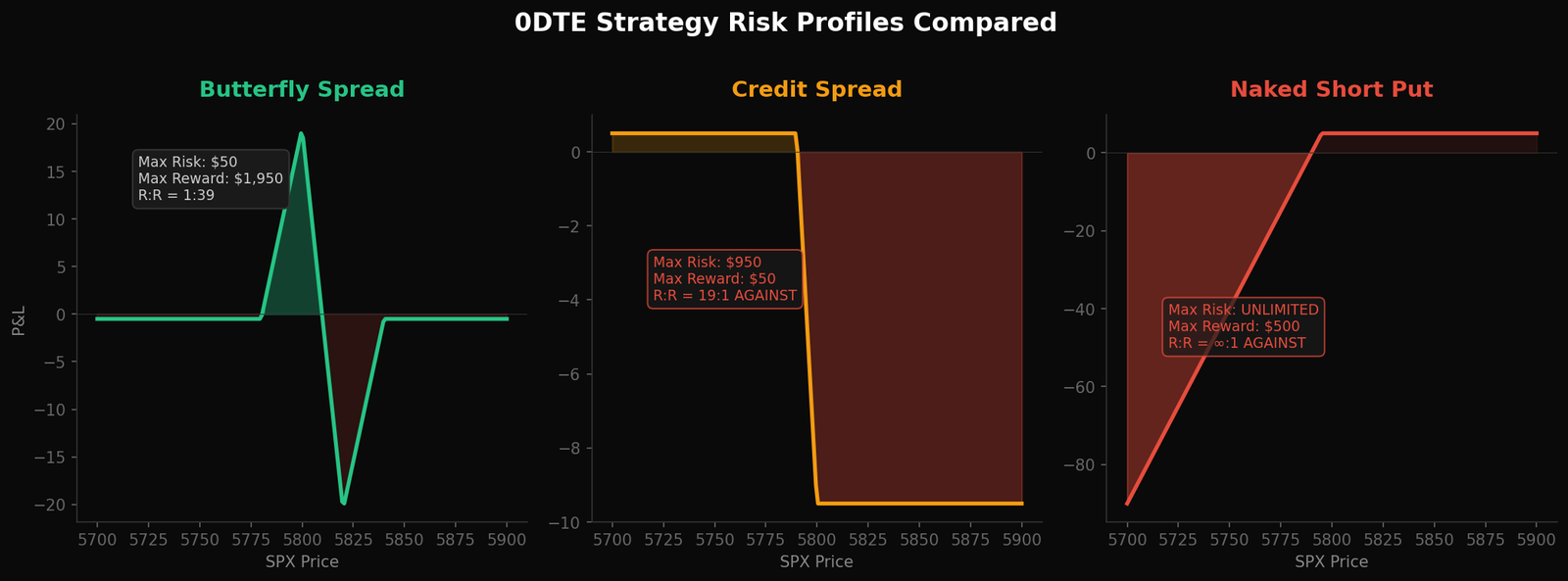
The butterfly spread is the core 0DTE structure. A butterfly costs a small debit — that debit is your maximum loss. If price settles near the body of the butterfly at expiration, the return is 5x to 25x the cost. No other structure offers that risk-reward ratio on a same-day contract. You know your max loss before you enter. You know your target. And the structure rewards precision over prediction.
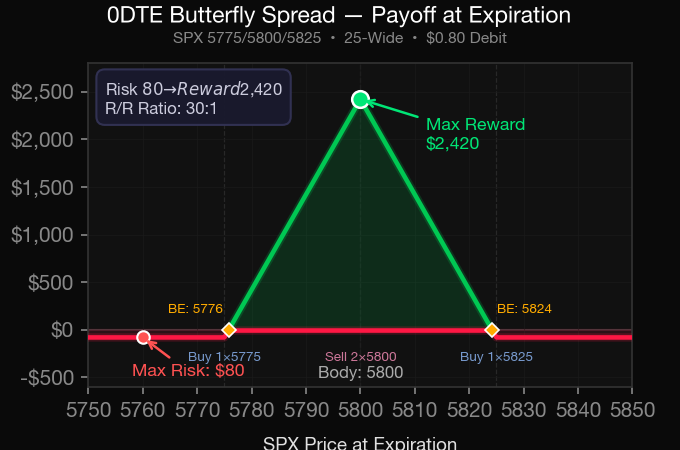
Butterfly width adjusts to the VIX regime. In low-volatility environments (VIX under 15), a 10-point-wide butterfly on SPX captures the compressed range. As VIX rises, widen to 20 or 30 points to accommodate the larger expected move. The width is not a personal preference — it is a function of the regime. Match the structure to the environment, not to your opinion.
Directional butterflies outperform neutral butterflies on 0DTE. A neutral butterfly placed at the current price profits only if the market stays still. A directional butterfly placed at a GEX-identified target profits if price migrates toward that level during the session. Since 0DTE price action tends to trend toward dealer gravity levels, a directional butterfly aligned with the structural context has a higher probability of hitting its target than a static neutral position.
Credit spreads look tempting but carry hidden risk. Selling a credit spread on 0DTE collects a small premium with a high probability of profit. But the risk-reward is inverted — you risk $500 to make $50. One adverse move, one gamma squeeze, and the loss wipes out weeks of winners. Credit spreads on 0DTE are a slow bleed disguised as a winning strategy.
Timing Your Entry: When the Edge Appears
On 0DTE, timing is not about catching the bottom or top. It is about entering when the structural context has resolved enough to give you a readable setup.
The first 30 minutes are noise. The opening range on SPX is driven by overnight positioning, gap fills, and order flow that has nothing to do with the session’s structural context. Entering a butterfly in the first 15 minutes means placing a structural trade before the structure has revealed itself. Most experienced 0DTE traders wait until at least 10:00 AM ET before considering an entry.
The mid-session convergence is where butterflies work. Between 10:30 and 1:00 PM ET, price typically begins trending toward the session’s dominant dealer gravity level. This is when the structural context — GEX positioning, expected move decay, volume profile — becomes actionable. A butterfly placed at the gravity level during this window has maximum time for price to converge while theta works in your favor.
Late-session entries carry accelerated gamma risk. After 2:00 PM ET, gamma on at-the-money 0DTE options accelerates sharply. A 5-point move in SPX can swing a butterfly’s value by 300% in either direction. Late entries can work for experienced traders who understand the gamma dynamics, but they are not where you start. If you are learning how to trade 0DTE options, focus on mid-session setups where the risk profile is more manageable.
Economic releases create before-and-after regimes. If CPI prints at 8:30 AM, the session before the print is one regime and the session after is another. Do not carry a position through a major print — the implied volatility repricing will distort your structure’s value regardless of direction. Wait for the print, let the first 15-20 minutes of reaction play out, then read the new structural context.
Risk Management for Same-Day Expiration Trading
Risk management is not a chapter you read and move on from. On 0DTE, it is the operating system that everything runs on. Get it wrong and nothing else matters.
Define your max loss before the session, in dollars. Not “I will see how it goes.” A hard number. If your account is $25,000 and your daily risk budget is 2%, your max loss is $500. That means if you are trading $2.00 butterflies, you can trade 2-3 contracts maximum. This calculation happens before the market opens, not during the session when emotions are running.
Position sizing is more important than strike selection. A perfectly placed butterfly at the right level still loses if you sized it at 10% of your account and it does not converge. A mediocre placement at conservative size loses a small amount and keeps you in the game for tomorrow. The traders who survive their first year of 0DTE are the ones who sized small enough to absorb the inevitable losing streaks.
One structure per session when you are learning. The temptation to place multiple butterflies across different levels is strong. Resist it. Each additional position increases your dollar exposure and your cognitive load. When you are developing your process, one clean trade with clear reasoning is worth more than three scattered trades you cannot manage simultaneously.
Accept that most butterflies expire worthless. A butterfly that costs $1.50 and pays $15 at target only needs to hit one out of every ten times to break even. The win rate is low. The expectancy is positive. If you cannot stomach watching seven or eight trades expire at zero before one hits, 0DTE butterflies will feel like losing even when the math is working. Understand the distribution before you start.
How to Trade 0DTE SPY Options vs SPX
If you are deciding between SPY and SPX for 0DTE trading, the differences matter more than most beginners realize.
SPX options are European-style and cash-settled. There is no early assignment risk. At expiration, if your option is in the money, you receive cash — not shares. This makes SPX structurally cleaner for defined-risk strategies like butterflies. You never wake up Monday morning holding 100 shares of an ETF because your short leg was assigned Friday afternoon.
SPX receives favorable tax treatment under Section 1256. Gains on SPX options are taxed at a blended rate — 60% long-term, 40% short-term — regardless of how long you held the position. SPY options are taxed entirely at short-term capital gains rates. Over a year of active trading, this difference compounds significantly.
SPY options are 1/10th the notional size, which matters for small accounts. One SPX butterfly might cost $150-300 in premium. The equivalent SPY butterfly costs $15-30. If your account is under $10,000, SPY lets you size appropriately without over-concentrating. Learn how to trade 0DTE spy options at smaller size, then scale to SPX as your account and confidence grow.
SPX has tighter percentage spreads on most strikes. Because SPX options have higher notional value and institutional participation, the bid-ask spread as a percentage of the option’s price is typically tighter than SPY. This matters on butterflies where you are crossing the spread on three legs simultaneously. Better fills mean better entries, which compound over hundreds of trades.
The Mistakes That Destroy 0DTE Trading Accounts
The failure modes for 0DTE traders are predictable. Every one of them stems from abandoning process under pressure.
Oversizing after a win. You hit a 15:1 butterfly and decide you have “figured it out.” The next session you triple your size. The market does not care about your last trade. The structural context is new every day. Size based on your risk budget, not your recent results.
Revenge trading after a loss. Your butterfly expired worthless and you immediately enter another one to “make it back.” This is not trading — it is gambling with a narrative attached. If your first trade followed your process and lost, accept the loss. If it did not follow your process, the fix is discipline, not another trade.
Trading without reading the session context. Placing a butterfly because “SPX is at 5620 and that is near a round number” is not a structural thesis. If you have not read the GEX profile, checked the expected move, and understood the VIX regime, you are not trading structurally — you are guessing with a defined-risk wrapper.
Holding through major economic prints. The implied volatility repricing around CPI, FOMC, and jobs reports can swing a butterfly’s value wildly even if price does not move much. Close or avoid positions around major prints. The edge exists in normal sessions, not in binary events.
Ignoring the losing streaks. A strategy with a 20-30% win rate will produce runs of 5, 7, even 10 consecutive losers. This is mathematically normal. If your position sizing is correct, these streaks are uncomfortable but survivable. If you quit or blow up during a losing streak, you never reach the winners that make the math work.
Frequently Asked Questions
How do you trade 0DTE options for beginners?
Start with a single butterfly spread on SPX or SPY per session. Read the structural context — GEX positioning, expected move, VIX regime — before the market opens. Enter one position during the mid-session window (10:30 AM to 1:00 PM ET) at a level supported by dealer gravity data. Risk no more than 1-2% of your account per session. Track every trade, review every outcome, and focus on developing process before chasing returns.
What is the best strategy for 0DTE options?
The butterfly spread is the dominant structure for 0DTE options trading because it offers defined risk with asymmetric payoff potential. A butterfly costs a small debit — your maximum loss — and returns 5x to 25x that debit if price settles near the body at expiration. Unlike credit spreads, the risk-reward ratio favors the buyer, making it sustainable through the low win rates inherent in same-day expiration trading.
How much money do you need to trade 0DTE options?
You can start trading 0DTE SPY butterflies with as little as $500-1,000, since individual SPY butterflies cost $15-50 in premium. For SPX butterflies, which cost $150-500 each, a $5,000-10,000 account provides enough room to size properly while following a 1-2% daily risk budget. The minimum is less important than the discipline — size so that a losing streak does not end your trading.
Can you trade 0DTE options on SPY?
Yes. SPY offers 0DTE options on Monday, Wednesday, and Friday expirations. SPX offers 0DTE every trading day. SPY options are American-style (assignment risk exists) and 1/10th the notional size of SPX. For smaller accounts, SPY 0DTE is a practical starting point. For accounts above $10,000, most structural traders prefer SPX for its cash settlement, tax advantages, and daily expiration availability.
Is 0DTE options trading profitable?
It can be, but profitability requires a structural approach, disciplined risk management, and the psychological ability to withstand low win rates. A butterfly strategy that wins 20-30% of the time is profitable if the average winner is 8-15x the average loser. Most traders fail at 0DTE because they oversize, abandon their process, or cannot tolerate the losing streaks that are mathematically built into the strategy. The traders who succeed treat it as a long-term edge, not a daily income source.
Start With Structure, Not Hope
Learning how to trade 0DTE options is a process that unfolds over weeks and months, not a single session. The mechanics are straightforward — read the context, choose a structure, size correctly, manage the trade. The difficulty is in the execution, the discipline, and the patience to stay consistent while the math plays out.
Fly on the Wall was built for traders who want to learn this process inside a community that trades it every session. Every day starts with structural analysis — GEX positioning, expected move, dealer gravity levels — followed by live discussion as the session unfolds. You see the reasoning behind every setup, ask questions in real time, and develop your own decision-making process alongside experienced structural traders.
Start with Observer ($17/week) for daily pre-market analysis and full community access. Step up to Activator ($97/month) for real-time GEX tools, live execution discussion, and weekly coaching. Or go all-in with Navigator ($267/month) for daily direct coaching with Ernie. Compare all plans here.