


Day trading SPX options is not the same as day trading stocks with options attached. The S&P 500 index is a derivative — you cannot buy or sell the index directly. The options on it are cash-settled, European-style contracts driven by dealer hedging, institutional positioning, and structural flows that most retail traders never learn to read. That structural layer is what makes SPX the best instrument for intraday options trading — and what makes it unforgiving for traders who approach it with chart patterns and gut feel.
This guide covers the structural approach to day trading SPX options: how to read the session context before you trade, how to choose the right expiration and structure, and how to avoid the mistakes that destroy most intraday options accounts. If you are new to SPX, start with the SPX options guide. If you already understand the mechanics and want to know how to day trade them effectively, read on.
Why SPX Is the Best Instrument for Intraday Options Trading
SPX options dominate intraday trading for reasons that go beyond name recognition. The structural advantages are real and compounding.
Cash settlement eliminates assignment risk. When you trade SPY options intraday, a short leg that goes in the money can result in share assignment — a margin event that turns a defined-risk trade into an open-ended position overnight. SPX options settle in cash. If your short strike is in the money at expiration, you receive or pay the cash difference. No shares. No margin surprises. No Monday morning nightmares. For day traders running multi-leg structures, this is not a minor convenience — it is a structural necessity.
Section 1256 tax treatment favors active traders. SPX options qualify for 60/40 tax treatment regardless of holding period — 60% of gains taxed at long-term rates, 40% at short-term. If you are day trading SPX options across hundreds of sessions per year, this blended rate saves thousands of dollars annually compared to the short-term capital gains rate you pay on SPY options.
Daily expirations create fresh opportunities every session. SPX offers 0DTE options every trading day of the week. Weekly and monthly expirations layer on top. This means you can always find a contract with the right amount of time decay and gamma exposure for your thesis. No other index product offers this depth of expiration choice for intraday traders.
Institutional participation creates tighter markets. SPX options attract hedge funds, proprietary trading firms, and market makers at scale. That institutional participation means tighter bid-ask spreads as a percentage of the option price, deeper order books, and more consistent pricing. When you are crossing the spread on a three-leg butterfly, the quality of the market you are trading in matters enormously.
The Structural Approach to Day Trading SPX Options
Most retail traders approach SPX day trading with the same toolkit they use for stocks: candlestick charts, support and resistance lines, RSI, MACD. These tools were built for price-action analysis. SPX intraday price action is driven primarily by options order flow and dealer hedging — forces that do not appear on a price chart.
Structural trading reads positioning, not price patterns. Instead of asking “where has price bounced before?” a structural trader asks “where are dealers positioned to stabilize or amplify price?” The answer comes from gamma exposure (GEX) data — a map of dealer hedging obligations across every strike. This map reveals where buying pressure and selling pressure will emerge mechanically, regardless of what the chart looks like.
The expected move replaces arbitrary targets. Chart traders set profit targets based on previous highs, Fibonacci levels, or moving averages. Structural traders use the expected move — the range the options market is pricing for the session, derived from the at-the-money straddle. This is not an opinion. It is the market’s consensus probability distribution, and it defines the playing field for the entire session.
Structures replace directional bets. Day trading SPX options structurally means placing defined-risk butterfly spreads at levels where dealer positioning data indicates price is likely to converge — not buying calls because you think the market is going up. The butterfly costs a small debit (maximum loss) and returns 5x to 25x that debit if price reaches the target. You are not predicting direction. You are identifying structural magnets and placing asymmetric bets on convergence.
Reading the Session: GEX, Expected Move, and VIX Regime
Every SPX session has a structural fingerprint. Reading it before the open is the foundation of the entire day trading process.
GEX determines how the market will behave. Positive GEX means dealers are long gamma — they buy dips and sell rallies, compressing the range. Price tends to stay pinned near high-concentration strikes. Negative GEX means dealers are short gamma — they sell into declines and buy into rallies, expanding the range. The GEX profile is the single most important input for day trading SPX options because it tells you whether to expect a tight, mean-reverting session or a trending, volatile one.
The expected move sets the session boundaries. Derived from the at-the-money straddle price, the expected move gives you the range that encompasses roughly 68% of probable outcomes. On a $2.50 straddle with SPX at 5600, the expected move is approximately 25 points — meaning the market is pricing a range of roughly 5575 to 5625. Your butterfly placement should reference this range, not arbitrary chart levels.
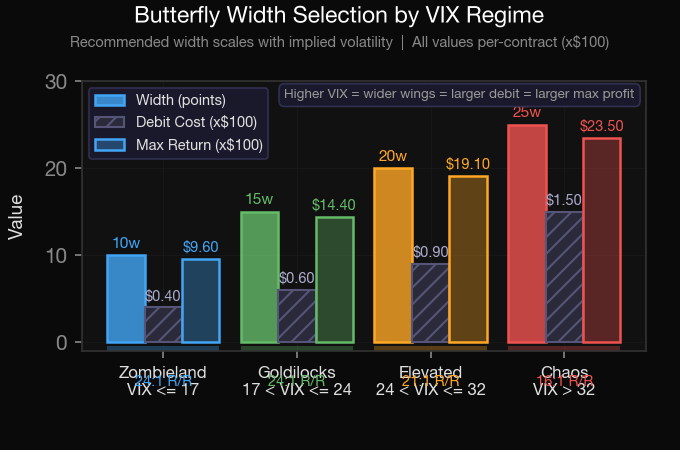
The VIX regime determines structure width and position size. When VIX is below 15, sessions are compressed — 10-point-wide butterflies work well and you can size more aggressively. When VIX is above 25, sessions are wide and violent — you need 20-30 point butterflies with smaller size to accommodate the larger swings. The VIX is not a trade signal. It is the regime indicator that calibrates everything else.
The economic calendar creates regime shifts within the session. FOMC, CPI, jobs reports, and other scheduled releases split the session into distinct regimes. The expected move before CPI is different from the expected move after. Dealer positioning shifts as the print hits. Do not carry positions through major releases — close or avoid, then re-read the structural context after the print and react to the new regime.
Choosing Your Expiration: 0DTE vs Weekly vs Monthly
One of the key decisions when trading SPX intraday is which expiration to use. Each has different characteristics that suit different situations.
0DTE (same-day expiration) offers maximum gamma and fastest theta decay. The options expire at the end of the session, which means gamma is extreme — small moves in SPX create large changes in option value. This makes 0DTE ideal for butterfly structures that profit from price convergence within a single session. The risk is well-defined because the position resolves by 4:00 PM ET regardless.
Weekly expirations (1-4 days out) provide more time but less gamma. A butterfly placed on Monday using Wednesday’s expiration has two extra days for price to converge on the target — but the gamma is lower, which means the payoff profile is flatter and the maximum return is smaller relative to the debit. Weekly expirations work well when you want to capture a multi-session thesis — for example, a GEX regime that you expect to persist for several days.
Monthly expirations are rarely optimal for intraday positions. The premium is higher, the gamma is much lower, and the theta decay per session is minimal. If you are using SPX options for the intraday structural edge, monthly options dilute that edge. They are better suited for swing positions or hedging, not for the session-by-session structural trades that define this approach.
Match the expiration to the thesis timeframe. If your thesis is “price will converge on the dealer gravity level during today’s session,” use 0DTE. If your thesis is “this GEX regime will push price toward this level over the next two sessions,” use the nearest weekly. Never use more expiration than your thesis requires — extra time costs premium without adding structural edge.
SPX vs SPY for Day Trading Options
The choice between SPX and SPY for day trading is not just about preference. The structural differences affect execution, risk, and long-term returns.
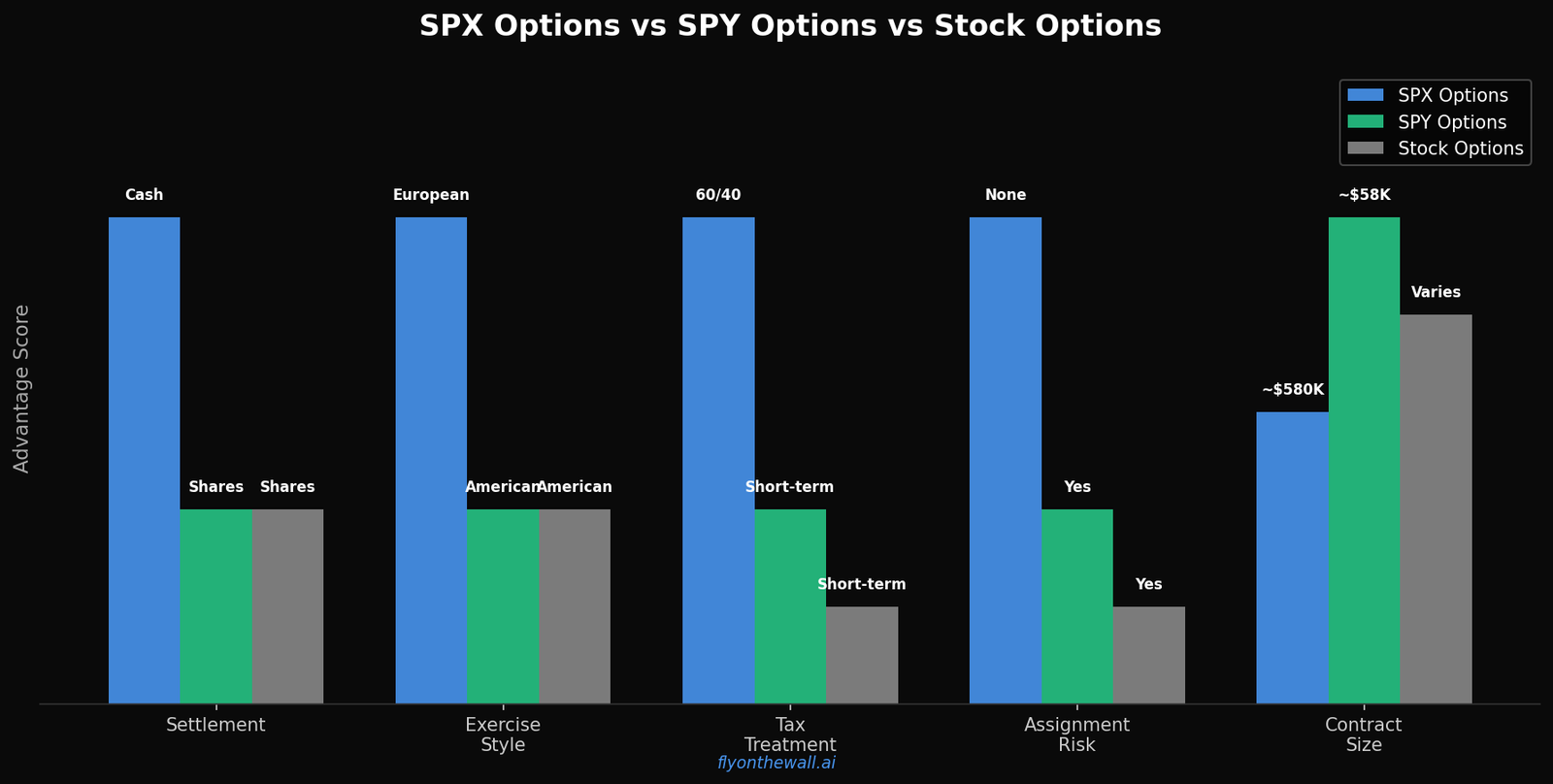
SPX is superior for most day traders above $10,000. Cash settlement, Section 1256 tax treatment, daily 0DTE availability, and tighter percentage spreads all favor SPX. A detailed comparison of the two instruments shows that SPX is structurally built for defined-risk intraday trading. The only real advantage SPY offers is smaller notional size.
SPY works for small accounts that need fractional sizing. An SPX butterfly might cost $150-300. A comparable SPY butterfly costs $15-30. If your account is under $10,000 and a single SPX butterfly represents more than 2-3% of your capital, SPY lets you size appropriately. Start with SPY, build the account and your skills, then migrate to SPX when the math supports it.
Do not trade both simultaneously when learning. SPX and SPY move in lockstep, but the options chains have different characteristics — different open interest distributions, different dealer positioning, different Greeks per dollar of premium. Pick one, learn its specific behavior deeply, and only expand to the other once you have a repeatable process on your primary instrument.
Common Mistakes When Day Trading SPX Options
The mistakes that destroy SPX day trading accounts are predictable. They stem from treating SPX options like stock trades and ignoring the structural forces that drive intraday price action.
Using technical analysis as a primary framework. Moving averages, RSI overbought/oversold, and candlestick patterns were designed for price-action instruments. SPX intraday price action is driven by dealer hedging flows that do not care about the 20-period moving average. Technical analysis can complement structural analysis — but if it is your primary framework for day trading SPX options, you are bringing the wrong tools to the job.
Buying naked calls or puts for directional bets. A long call on SPX that expires today costs a large premium and requires a directional move plus enough movement to overcome theta decay. The probability of profit is low and the sizing is inefficient. A butterfly at the same target costs a fraction of the premium and offers better risk-reward. Defined-risk structures outperform directional bets on every metric that matters for day trading.
Ignoring the session context entirely. Placing a trade because “SPX is near a round number” or “it sold off so it should bounce” is not a thesis. Without reading the GEX profile, expected move, and VIX regime, you are gambling with a sophisticated instrument. The edge in day trading SPX options comes from reading the structural context. Without it, there is no edge.
Oversizing based on recent results. A winning streak does not mean you have solved the market. It means the distribution has been kind recently. The risk management framework — 1-2% of the account per session, defined max loss before the open — does not change based on results. The traders who survive long enough to become consistently profitable are the ones who never abandoned their sizing rules.
Trading through major economic releases. CPI, FOMC, and jobs reports create implied volatility dislocations that can swing a butterfly’s value by 50-100% regardless of direction. The structural context before the print is different from the context after. Close positions before the release, wait for the print, re-read the landscape, and only then consider a new trade.
Frequently Asked Questions
Can you day trade SPX options?
Yes. SPX options are among the most actively day traded instruments in the world. They offer 0DTE expirations every trading day, cash settlement with no assignment risk, and favorable 60/40 tax treatment under Section 1256. Because SPX options are index options and not equity options, they are also exempt from the pattern day trader rule that applies to stocks — though your broker may have its own margin requirements.
Is day trading SPX options profitable?
It can be with the right approach. Structural day trading using defined-risk butterflies placed at GEX-identified levels is a positive-expectancy strategy — the win rate is low (20-30%), but winners pay 5-25x the risk. Profitability requires disciplined position sizing, a consistent process for reading the session context, and the psychological ability to withstand consecutive losses. Most traders who fail at SPX day trading do so because they oversize, chase direction, or abandon their process during drawdowns.
What is the best strategy for day trading SPX options?
The butterfly spread is the most effective structure for intraday SPX trading because it offers defined risk, asymmetric payoff, and benefits from the gamma dynamics unique to short-dated options. Placed at dealer gravity levels identified through GEX analysis, a butterfly profits from price convergence — the structural tendency of SPX to gravitate toward levels where dealer hedging flows stabilize. The full butterfly strategy guide covers the mechanics in detail.
How much money do you need to day trade SPX options?
A functional starting account for SPX day trading is $5,000-10,000. Individual butterfly spreads cost $100-400 in premium, and proper risk management (1-2% of account per session) means you need enough capital to absorb losing streaks without being forced to oversize. For smaller accounts under $5,000, starting with SPY options at 1/10th the notional size is a practical alternative.
What is the difference between day trading SPX and SPY options?
SPX options are cash-settled, European-style, and receive 60/40 tax treatment. SPY options are American-style with assignment risk, taxed entirely at short-term rates, and 1/10th the notional size. SPX offers 0DTE expirations every day; SPY offers them Monday, Wednesday, and Friday. For accounts above $10,000, SPX is structurally superior. For smaller accounts, SPY provides the same exposure at a size that allows proper risk management.
Trade SPX With Structure, Not Speculation
Day trading SPX options is not about predicting whether the market goes up or down. It is about reading the positioning landscape that order flow creates, identifying where structural pressure concentrates, and placing defined-risk trades at convergence targets. The process is the same every session — read GEX, check the expected move, assess the VIX regime, and position accordingly.
Fly on the Wall was built for traders who want to learn this structural approach inside a community that executes it every session. The daily pre-market analysis gives you the positioning landscape before the open. The live session discussion shows you how experienced structural traders read and react to the session in real time. And the risk management framework keeps you in the game long enough for the math to work.
Start with Observer ($17/week) for daily structural analysis and community access. Step up to Activator ($97/month) for real-time GEX tools, dealer gravity levels, and weekly coaching. Or go all-in with Navigator ($267/month) for daily direct coaching with Ernie. Compare all plans here.