


Everyone tells you to learn options trading. Very few tell you how — not what options are, but how to actually structure the learning process so that six months from now you can read a market, place a defined-risk trade, and manage it through a live session without relying on someone else’s calls.
The problem with most learning paths is that they are content-first. Watch these videos. Read this book. Take this quiz. Content is necessary, but content without a practice framework produces knowledgeable spectators, not competent traders. This guide lays out a practical roadmap for learning options trading — what to study at each stage, how to practice effectively, and what milestones signal that you are ready to move to the next level.
Why Most People Fail to Learn Options Trading
The failure rate is not because options are impossibly complex. It is because the standard learning process has structural flaws that almost guarantee failure.
Consuming content is not the same as learning. Watching fifty YouTube videos on options strategies creates the feeling of progress without the reality of it. You can explain what a butterfly spread is without being able to identify when the market conditions favor one. The gap between “I understand the concept” and “I can apply it under pressure in real time” is where most self-taught traders stall indefinitely.
Skipping fundamentals to reach strategies is the most common mistake. New traders want to learn strategies immediately because strategies feel like the path to making money. But a strategy without the underlying knowledge — how the Greeks work, what drives options order flow, how dealer positioning creates structural pressure — is just a recipe without understanding the ingredients. You can follow it mechanically, but you cannot adapt when conditions change.
Learning in isolation is slow and error-prone. A trader studying alone has no one to correct misunderstandings, challenge assumptions, or point out blind spots. They develop habits — good and bad — without feedback. The bad habits compound silently until they produce a loss large enough to demand attention. An active trading community compresses the feedback loop from months to days.
Paper trading too long delays the real education. Simulated trading removes the emotional component that drives 80% of real trading mistakes. A trader who paper trades for six months and then switches to real money discovers that everything feels different — the hesitation, the fear of loss, the urge to overtrade after a win. Paper trading teaches mechanics. Real trading teaches discipline. Both are necessary, and the transition should happen sooner than most people think.
The Four-Stage Roadmap to Learn Options Trading
This roadmap is built for traders who want to learn options trading with a structural approach — specifically, trading SPX options using defined-risk strategies informed by dealer positioning. The stages are sequential. Each one builds on the previous, and skipping ahead creates gaps that cost real money later.
Stage 1: Build the Foundation (Weeks 1-3)
Start with the mechanics. Understand what calls and puts are, how strike prices and expirations work, what an options chain looks like, and how options are priced. This is the vocabulary stage — you need to speak the language before you can have a conversation.
Resources for this stage are abundant and free. Broker education centers (Thinkorswim, Fidelity, Schwab) all offer structured introductory content. The OCC’s options education portal provides excellent foundational material. The options trading for beginners guide covers the structural perspective on getting started.
Milestone: You can look at an options chain, identify calls and puts, read the bid-ask spread, and calculate the intrinsic and extrinsic value of any contract. You understand what “in the money,” “at the money,” and “out of the money” mean without looking it up.
Stage 2: Master the Greeks as Live Instruments (Weeks 3-6)
The Greeks are not theoretical concepts. They are the dashboard instruments you will read every time you have an open position. This stage transforms them from exam answers into practical tools.
Delta: open a paper trading account, buy a call, and watch delta change as the underlying moves. Notice how a 30-delta call behaves differently from a 70-delta call. Gamma: watch how delta accelerates as the option moves deeper in the money, especially on 0DTE contracts where gamma is extreme. Theta: hold a position overnight and observe the time decay — then hold a 0DTE position for an hour and observe how much faster theta eats the premium. Vega: watch what happens to option prices before and after a major economic release, and connect that to implied volatility crush.
Milestone: Before entering any position, you can describe your delta exposure, estimate your theta cost per hour, and identify your vega risk. You do this naturally, not as a checklist.
Stage 3: Understand Market Structure and Context (Weeks 6-10)
This is the stage that most learning paths skip entirely — and it is where structural traders diverge from everyone else. Before learning any strategy, you need to understand what moves the market you are trading.
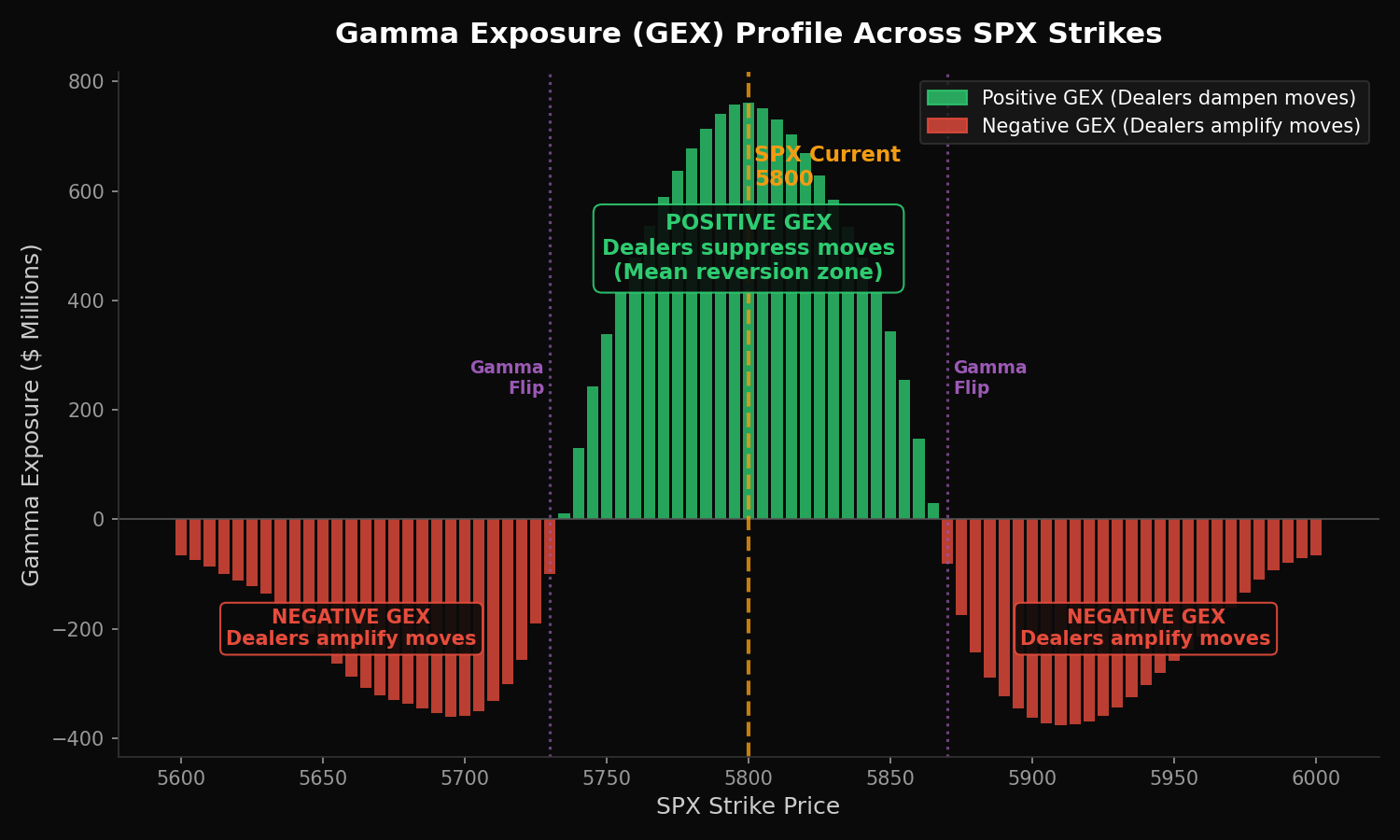
Study options market structure — how dealer hedging creates buying and selling pressure at specific strikes. Learn to read gamma exposure (GEX) profiles and understand what positive and negative GEX mean for session behavior. Understand the expected move and how it defines the range the market is pricing for any given session. Study how the VIX regime determines the character of the trading day.
This is the knowledge that transforms options trading from guessing direction to reading structural pressure. It is the foundation of the entire FOTW approach, and it is what makes day trading SPX options a structural discipline rather than a speculative exercise.
Milestone: Before the market opens, you can read the GEX profile, calculate the expected move, identify the VIX regime, and describe what kind of session you expect — compressed and mean-reverting, or expanded and trending. You do this before considering any trade.
Stage 4: Apply Defined-Risk Strategies in Live Markets (Weeks 10+)
Now — and only now — you start placing real trades. The strategy selection is informed by everything you learned in Stages 1-3.
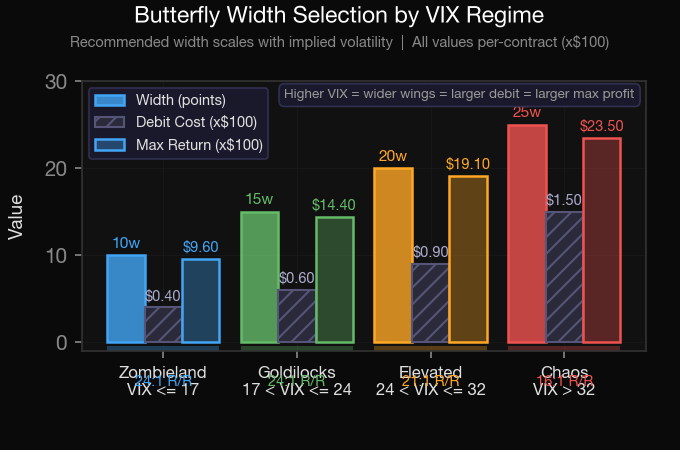
Start with butterfly spreads. They cost a small, fixed debit (maximum loss), target a specific price level, and return 5x to 25x the risk when price converges on the target. This asymmetric structure means you do not need to win most of the time. A 20-30% hit rate with a 10:1 average payoff is profitable. Start with SPY butterflies at $15-30 per trade if your account is under $10,000. Migrate to SPX when the sizing math supports it.
Follow strict risk management from the first trade: 1-2% of account per position, defined maximum daily loss, and stop trading for the day when you hit that limit. These rules are not suggestions. They are the mechanism that keeps you in the game through the losing streaks that every strategy — even profitable ones — inevitably produces.
Milestone: You have placed 50+ live trades following the same process — read context, identify target, place butterfly, manage risk. Your focus is on process consistency, not individual trade outcomes. You can describe your approach in one paragraph without mentioning any specific trade.
The Practice Framework That Builds Skill
Studying options and practicing options are different activities. Both are necessary, and most people over-index on studying.
The 30/70 rule: spend 30% of your time studying, 70% practicing. After Stage 1, the majority of your learning time should be spent in application — reading live GEX profiles, calculating expected moves on real sessions, identifying where you would place a butterfly and why. Watching another video about the Greeks is not practice. Calculating the theta decay on your actual position over the last hour is practice.
Keep a trading journal from the first live trade. Record the session context (GEX regime, expected move, VIX level), the trade (structure, strikes, debit paid), the reasoning (why this target, why this width), and the outcome. Review the journal weekly. The patterns that emerge — when you make money, when you lose money, what conditions you misread — are the most valuable feedback you will receive.
Debrief every session, especially losing ones. After a loss, ask: was the read correct and the market just did not cooperate, or was the read wrong? If the read was correct, the loss is part of the math — move on. If the read was wrong, identify what you missed and add it to your pre-trade checklist. Losses that teach you something are investments. Losses you do not analyze are just expenses.
Resources at Every Stage
Different resources serve different stages. Using the right resource at the right time accelerates learning. Using the wrong one wastes time.
Stage 1 (Mechanics): Free broker education, OCC portal, and introductory blog content. Do not pay for this stage — the information is standardized and widely available.
Stage 2 (Greeks): A paper trading platform where you can watch Greeks change in real time (Thinkorswim’s analyze tab is excellent for this). The FOTW Greeks guide covers the practical application.
Stage 3 (Market Structure): This is where quality paid resources add genuine value. Understanding dealer positioning, GEX analysis, and structural flow reading requires material that most free content does not cover. The FOTW educational library — from gamma exposure through order flow — covers this stage comprehensively.
Stage 4 (Live Application): A live trading environment where you can see the framework applied daily. This is where Observer ($17/week) provides the most value — daily pre-market structural analysis, the community discussing trades in real time, and the feedback loop that accelerates skill development. Activator ($97/month) adds real-time GEX tools and weekly coaching. Navigator ($267/month) adds daily direct coaching with Ernie.

Frequently Asked Questions
How do I learn options trading from scratch?
Start with the mechanics (calls, puts, strikes, expirations) using free broker resources. Then learn the Greeks as practical tools by watching them change in real time on a paper trading platform. Next, study market structure — what actually drives price in the instrument you plan to trade. Finally, begin placing small, defined-risk trades in live markets while following strict risk management rules. Each stage takes two to four weeks of focused effort.
What is the best way to learn options trading?
The most effective approach combines structured study with live practice in a specific ratio — roughly 30% studying concepts, 70% applying them. Join a community where experienced traders discuss their reads and reasoning in real time. Keep a detailed trading journal and review it weekly. Focus on one instrument (SPX or SPY) and one strategy (butterfly spreads) until the process is consistent before expanding.
How long does it take to learn options trading?
The basic mechanics take two to three weeks. Developing comfort with the Greeks takes another three to four weeks. Understanding market structure and positioning takes four to six weeks. Reaching consistent live application — where you have a repeatable process and disciplined risk management — typically takes six to twelve months total. The timeline compresses significantly with structured education and an active community.
Can I teach myself options trading?
You can learn the fundamentals independently using free resources. However, self-teaching market structure, live application, and risk discipline is significantly slower than learning within a structured program with community feedback. Most self-taught traders spend one to two years reaching the level that guided traders reach in six months. The savings in avoided losses during that extra time typically exceed the cost of quality education.
What books should I read to learn options trading?
For mechanics and Greeks, “Options as a Strategic Investment” by McMillan remains the most comprehensive reference. For understanding volatility, Natenberg’s “Option Volatility and Pricing” is the standard. However, books cannot teach live market application or structural positioning — they cover the academic foundation. For the practical framework of reading positioning and trading defined-risk structures, live education and community practice are more effective than any book.
Start the Process That Leads to Independence
Learning options trading is not about finding the right strategy or the right indicator. It is about building a framework — a systematic process for reading the market, selecting a structure, managing risk, and improving through deliberate practice. The framework takes time to develop, but once it is internalized, it becomes the skill that generates returns for years.
Start with the beginner’s guide if you are at Stage 1. Explore the full education pathway to understand what each stage involves. And when you are ready for live application, join the FOTW community — start with Observer ($17/week) for daily structural analysis and community access. Compare all plans here.